
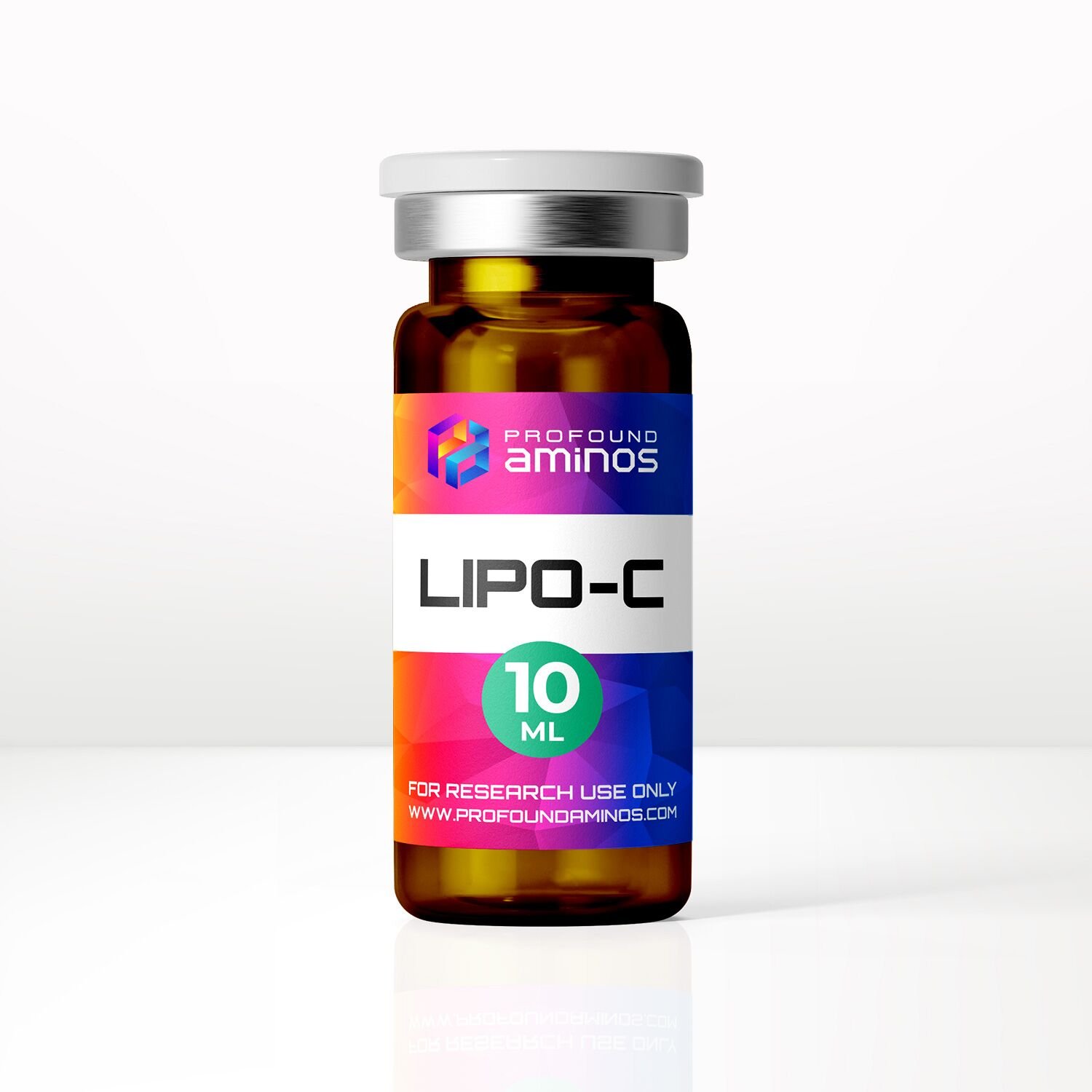
LIPO-C
$89.00
This is a 326mg Multi-Component Lipotropic Research Reagent designed strictly for laboratory investigation of hepatic lipid metabolism, mitochondrial fatty-acid oxidation pathways, and transmethylation biochemistry.
It features a lyophilized blend of five scientifically characterized components – L-Carnitine (200mg), L-Methionine (25mg), Myo-Inositol (50mg), Choline Chloride (50mg), and Cyanocobalamin (1mg) each targeting a distinct metabolic research endpoint. This formulation enables researchers to investigate simultaneous multi-pathway lipotropic effects in a single, standardized reagent batch.
Not for consumption, parenteral administration, or any application outside a
controlled laboratory setting.
1000 in stock
Lipo-C Lipotropic Research Complex
L-Carnitine (200mg) + Methionine (25mg) + Inositol (50mg) + Choline (50mg) + Cyanocobalamin (1mg)
FOR RESEARCH USE ONLY. Not intended for consumption, parenteral administration, therapeutic, or diagnostic application of any kind. For laboratory and preclinical research exclusively.
TECHNICAL SPECIFICATIONS
| Property | Data |
|---|---|
| Product Reference | Lipo-C Multi-Component Lipotropic Research Reagent |
| Chemical Class | Heterogeneous Lipotropic Nutrient-Amino Acid Reagent Blend |
| Physical Format | Lyophilized Powder — Hermetically Sealed Sterile Container |
| Net Reagent Content | 326 mass units total lyophilized content |
| Reagent Fraction 1 | L-Carnitine |
| CAS Registry | 541-15-1 |
| PubChem CID | 10917 |
| Molecular Formula | C7H15NO3 |
| Fraction Content | 200 mass units |
| Reagent Fraction 2 | L-Methionine |
| CAS Registry | 63-68-3 |
| PubChem CID | 6137 |
| Molecular Formula | C5H11NO2S |
| Fraction Content | 25 mass units |
| Reagent Fraction 3 | Myo-Inositol |
| CAS Registry | 87-89-8 |
| PubChem CID | 892 |
| Molecular Formula | C6H12O6 |
| Fraction Content | 50 mass units |
| Reagent Fraction 4 | Choline Chloride |
| CAS Registry | 67-48-1 |
| PubChem CID | 6145 |
| Molecular Formula | C5H14ClNO |
| Fraction Content | 50 mass units |
| Reagent Fraction 5 | Cyanocobalamin (Vitamin B12) |
| CAS Registry | 68-19-9 |
| PubChem CID | 5311498 |
| Molecular Formula | C63H88CoN14O14P |
| Fraction Content | 1 mass unit |
| Analytical Purity | ≥99% (RP-HPLC — per fraction) |
| Identity Confirmation | LC-MS — All five fractions verified |
| Endotoxin Screening | <0.25 EU (LAL method) |
| Reconstitution Buffer | Aqueous laboratory buffer / bacteriostatic-grade solvent |
| Storage — Lyophilized | 2–8°C, desiccated, light-protected |
| Storage — Reconstituted | -20°C, single-use aliquots advised |
| Regulatory Class | Research Use Only (RUO) — Not for administration to living organisms |
Disclaimer : For Research Use Only (RUO). Not for human use.
Product Overview
This product comprises a 326mg Multi-Component Lipotropic Research Reagent known as Lipo-C Complex. It combines five individual research-grade compounds, each with documented preclinical bioactivity in mitochondrial beta-oxidation, transmethylation cycling, phospholipid biosynthesis, hepatic lipid export, and cobalamin-dependent enzymatic cofactor pathways.
Unlike single-compound reagents limited to one metabolic endpoint, Lipo-C’s multi-component architecture enables researchers to study how five complementary metabolic systems interact simultaneously — making it uniquely valuable for comprehensive lipid metabolism and hepatic function assay design.
MOLECULAR STRUCTURE
Component 1: L-Carnitine — PubChem CID 10917
Molecular structure of choline chloride, composed of a choline cation and a chloride anion.
L-Carnitine (levocarnitine) is a naturally occurring quaternary ammonium compound with molecular formula C7H15NO3. It functions as the obligate carrier for long-chain fatty acyl-CoA esters across the inner mitochondrial membrane via the carnitine palmitoyltransferase (CPT) shuttle system. The trimethylammonium group enables membrane interaction
while the hydroxyl group participates in ester bond formation with fatty acyl chains. Research applications include mitochondrial beta-oxidation flux measurement, CPT-I/CPT-II kinetics studies, and fatty-acid metabolism pathway investigation in hepatocyte models.
Component 2: L-Methionine — PubChem CID 6137
Molecular structure of L-methionine, an essential sulfur-containing amino acid.
L-Methionine is an essential sulphur-containing amino acid with molecular formula C5H11NO2S. It serves as the sole precursor for S-adenosylmethionine (SAMe), the universal methyl-group donor in biological methylation reactions. Methionine adenosyltransferase (MAT) catalyses the ATP-dependent conversion of methionine to SAMe, which subsequently donates its methyl group to substrates including DNA (via DNMT enzymes), histones, and phospholipid headgroups. Research applications include transmethylation pathway quantification, homocysteine metabolism studies, and glutathione precursor analysis in hepatic models.
Component 3: Myo-Inositol — PubChem CID 892
Molecular structure of myo-inositol, a cyclic polyol with six hydroxyl groups.
Myo-Inositol is a carbocyclic sugar alcohol (cyclohexanehexol) with molecular formula C6H12O6. It is the most abundant inositol isomer in mammalian cells and serves as the structural backbone of phosphatidylinositol (PI), a key membrane phospholipid. Phosphorylation of PI generates signalling molecules including PIP2 and PIP3, which activate downstream cascades such as PI3K/Akt and IP3-mediated calcium mobilisation. Research applications include insulin-signalling pathway studies, phospholipid turnover quantification, and second-messenger system investigation in metabolic cell models.
Component 4: Choline Chloride — PubChem CID 6145
Molecular structure of choline chloride, composed of a choline cation and a chloride anion.
Choline is a quaternary ammonium cation with molecular formula C5H14NO (supplied as choline chloride, C5H14ClNO).
It is an essential nutrient required for phosphatidylcholine (PC) biosynthesis via the CDP-choline (Kennedy) pathway. PC constitutes approximately 50% of mammalian membrane phospholipids and is the dominant surface phospholipid on VLDL particles, making choline critical for hepatic lipoprotein assembly and triglyceride export. Choline also serves
as the precursor for the neurotransmitter acetylcholine and the methyl donor betaine. Research applications include Kennedy pathway flux measurement, VLDL secretion assays, and hepatic steatosis modelling.
Component 5: Cyanocobalamin (Vitamin B12) — PubChem CID 5311498
Simplified structure illustration of cyanocobalamin, also known as vitamin B12.
Cyanocobalamin is a cobalt-containing corrinoid compound with molecular formula C63H88CoN14O14P. It is the most chemically stable form of vitamin B12, serving as a precursor for the biologically active cofactors methylcobalamin (MeCbl) and 5’-deoxyadenosylcobalamin (AdoCbl). MeCbl is the essential cofactor for methionine synthase (MTR), which remethylates homocysteine to methionine, linking B12 status directly to one-carbon metabolism and SAMe availability. AdoCbl cofactors methylmalonyl-CoA mutase (MUT), connecting odd-chain fatty acid and branched-chain amino acid catabolism to the citric acid cycle. Research applications include one-carbon metabolism pathway studies,
methylmalonic acid quantification, and homocysteine remethylation kinetics.
Research Mechanism -2026 Laboratory Applications
In 2026-era metabolic research, this reagent complex is utilized to study:
- Mitochondrial Fatty-Acid Transport & Beta-Oxidation : Investigating how L-Carnitine facilitates long-chain acyl-CoA translocation across the inner mitochondrial membrane via the carnitine palmitoyltransferase (CPT-I/CPT-II) shuttle system, enabling quantification of beta-oxidation flux in hepatocyte and myocyte culture models.
- Transmethylation & Homocysteine Metabolism : Examining how L-Methionine serves as the precursor for S-adenosylmethionine (SAMe) biosynthesis, supporting methyl-group donation to DNA, histones, and phospholipids via methionine adenosyltransferase (MAT) activity in hepatic cell-line assays.
- Phospholipid Signalling & Insulin-Pathway Modulation : Studying how Myo-Inositol integrates into phosphatidylinositol (PI) cycle dynamics, modulating PI3K/Akt signalling cascades and IP3-mediated calcium release in cellular metabolism research models.
- Hepatic Lipid Export & VLDL Assembly : Quantifying how Choline supports phosphatidylcholine (PC) biosynthesis via the CDP-choline (Kennedy) pathway, enabling VLDL particle assembly and hepatic triglyceride export in primary hepatocyte and HepG2 cell models.
- Cobalamin-Dependent Enzymatic Cofactor Activity : Measuring how Cyanocobalamin (Vitamin B12) functions as a cofactor for methionine synthase (MTR) and methylmalonyl-CoA mutase (MUT), linking folate metabolism to propionate catabolism and one-carbon transfer biochemistry in metabolic research assays.
COMPARATIVE RESEARCH CONTEXT — 2026 Lipotropic Reagent Landscape
| Feature | Lipo-C Complex | L-Carnitine Mono | MIC Blend (Generic) | B12 Mono |
|---|---|---|---|---|
| Components | 5 compounds | 1 compound | 3 compounds | 1 compound |
| Beta-Oxidation (Carnitine Shuttle) | ✓ L-Carnitine 200mg | ✓ | ✗ | ✗ |
| Transmethylation (SAMe Pathway) | ✓ Methionine 25mg | ✗ | ✓ Methionine | ✗ |
| PI3K/Akt Signalling (Inositol) | ✓ Inositol 50mg | ✗ | ✓ Inositol | ✗ |
| Hepatic Lipid Export (Kennedy Pathway) | ✓ Choline 50mg | ✗ | ✓ Choline | ✗ |
| One-Carbon Metabolism (B12 Cofactor) | ✓ B12 1mg | ✗ | ✗ (Not Included) | ✓ |
| Total Content | 326mg | 200mg typical | Variable | 1mg typical |
| Pathways Targeted | 5 simultaneous | 1 pathway | 3 pathways | 1 pathway |
KEY DIFFERENTIATOR: Lipo-C is the only standardized reagent in this category that combines the carnitine shuttle pathway (L-Carnitine) with transmethylation (Methionine), phospholipid signalling (Inositol), hepatic lipid export (Choline), AND one-carbon cofactor metabolism (B12) in a single lyophilized format. Generic MIC blends omit the carnitine shuttle and B12 cofactor pathways entirely
WHY SOURCE FROM PROFOUND AMINOS
- Five-Component Identity Verification
A standard purity test confirms what percentage of a container is the target compound it does not confirm which compound. Lipo-C contains five chemically distinct components. We verify each component individually via Mass Spectrometry (LC-MS), confirming molecular identity, purity, and content for all five fractions before batch release.
Purity without identity confirmation is an incomplete quality standard. - Single-Batch Homogeneity – The Research Reproducibility Advantage
Pooling individual components from separate sources introduces inter-batch variance that compromises assay reproducibility. Our Lipo-C 326mg format is blended at a fixed mass ratio (L-Carnitine 200mg : Methionine 25mg : Inositol 50mg : Choline 50mg : B12 1mg) in a single lyophilization run. Every aliquot a researcher prepares from this container contains an identical ratio of all five components improving R-squared values across experimental replicates. - Cold-Chain Integrity – USA Domestic Shipping
Reagent-grade compounds are thermally sensitive. International sourcing introduces uncontrolled temperature excursions during customs transit. Lipo-C ships exclusively within the USA via a monitored cold-chain logistics protocol from a climate-controlled facility directly to your research address – eliminating degradation risks inherent to overseas sourcing.
REGULATORY & COMPLIANCE STATEMENT (RUO)
| Classification Detail | Description |
|---|---|
| Regulatory Status | Research Use Only (RUO) — U.S. Federal Regulatory Framework |
| FDA Status | Not approved as a combined formulation. Individual components are recognised nutrients, but the blend is not evaluated for any therapeutic application. |
| Not a Drug | Not evaluated by FDA for safety or efficacy in any combined application. |
| Not a Supplement | Not a dietary supplement, nutraceutical, or consumer product. |
| Chemical Reference | Supplied solely for laboratory testing and preclinical investigation. |
| PPE Required | Gloves, lab coat, protective eyewear during reconstitution and handling. |
| CAS Safety Sheets | L-Carnitine: 541-15-1 · Methionine: 63-68-3 · Inositol: 87-89-8 · Choline Chloride: 67-48-1 · Cyanocobalamin: 68-19-9 |
FOR RESEARCH USE ONLY. NOT FOR HUMAN OR ANIMAL APPLICATION.
STRICT PROHIBITION : Promoting, distributing, or using this research reagent for any application involving administration to living organisms is strictly prohibited and constitutes a violation of U.S. federal law. This product is not manufactured, labeled, or intended for any pharmaceutical, therapeutic, or clinical application.
These statements have not been evaluated by the Food and Drug Administration. This product is not intended to diagnose, treat, cure, or prevent any disease.
Frequently Asked Questions
Q1: Is Lipo-C lipotropic complex intended for consumption or administration?
No. Lipo-C is strictly classified as a Research Use Only (RUO) reagent. It is not approved, labeled, or intended for consumption, parenteral administration, therapeutic use, or any diagnostic application. Purchase confirms agreement to institutional laboratory research use only.
Q2: What does the 326mg format mean?
The 326mg refers to total lyophilized content across all five components: L-Carnitine (200mg) + L-Methionine (25mg) + Myo-Inositol (50mg) + Choline Chloride (50mg) + Cyanocobalamin (1mg). The blend ratio is fixed at manufacture, ensuring uniform composition across all reconstituted aliquots from a single batch.
Q3: How do I reconstitute Lipo-C for laboratory use?
Lipo-C is soluble in bacteriostatic water or sterile PBS buffer. Researchers must calculate the target molar
concentration for their specific assay protocol before adding solvent. Reconstitute slowly using a swirling motion do not vortex solutions containing cyanocobalamin, as the corrin ring structure is light-sensitive.
Q4: Can reconstituted Lipo-C solution be stored?
Yes. Once reconstituted, aliquot immediately into working volumes and store at -20°C. Avoid repeated freeze-thaw cycles, which accelerate compound degradation and compromise assay reproducibility. Single-use aliquots are recommended. Protect reconstituted solution from light exposure to preserve cyanocobalamin integrity.
Q5: What makes Lipo-C different from a standard MIC reagent?
Lipo-C includes two components not present in generic MIC (Methionine-Inositol-Choline) formulations: L-Carnitine and Cyanocobalamin. L-Carnitine enables mitochondrial fatty-acid transport research via the CPT shuttle system.
Cyanocobalamin provides the essential cofactor for methionine synthase, linking B12 metabolism to one-carbon transfer and SAMe availability. These additions create two additional mechanistic research pathways that MIC alone does not address.
Q6: What is the FDA regulatory status of Lipo-C components?
The individual components of Lipo-C (L-Carnitine, Methionine, Inositol, Choline, Vitamin B12) are recognised nutrients with established safety profiles when used as dietary ingredients. However, the Lipo-C reagent blend as formulated here is not FDA-approved for any therapeutic application.
Compounded lipotropic formulations marketed for human use are subject to FDA enforcement under the FD&C; Act. In 2025–2026, FDA issued warning letters to multiple entities marketing lipotropic combinations with unapproved health claims. Lipo-C is sold exclusively as a research chemical under the RUO framework.
Q7: Does Lipo-C have published clinical trial data?
No peer-reviewed studies have evaluated the Lipo-C formulation as a unified product. Component-level research includes: extensive literature on L-Carnitine beta-oxidation (PubChem CID 10917 over 4,000 PubMed citations); methionine metabolism and SAMe biosynthesis studies; inositol PI-cycle signalling research; choline Kennedy pathway studies (reviewed in Zeisel SH, J Am Coll Nutr 2000); and B12 cofactor biochemistry. All component findings are preclinical or nutritional and do not constitute clinical evidence for the combined formulation.
Q8: Can Lipo-C be used outside a controlled laboratory research setting?
Absolutely not. This reagent is classified strictly for laboratory investigation only. Any non-laboratory use including personal, consumer, or wellness applications violates our Terms of Service and will result in immediate order cancellation. Refer to our Terms & Conditions for full compliance requirements.
Q9: Do you provide a COA for every batch?
Yes. Every Lipo-C batch includes a Certificate of Analysis verifying purity per component via RP-HPLC, identity confirmation via LC-MS for all five fractions, endotoxin screening (<0.25 EU/mg), lot number, and manufacturing date. Available for download per batch from our COA portal.
Q10: Why is L-Carnitine 200mg while other components are lower?
L-Carnitine requires higher mass loading because it functions as a stoichiometric carrier molecule — each carnitine molecule shuttles one long-chain fatty acyl-CoA across the mitochondrial membrane.
Effective beta-oxidation flux measurement in hepatocyte assays requires sufficient carnitine availability relative to fatty acid substrate.
The 200:25:50:50:1 ratio reflects established preclinical research protocols for multi-component lipotropic metabolism studies and ensures adequate carnitine saturation across the reconstituted research volume.
KEY REFERENCES — PubMed / PubChem Verified
| # | Reference | Source | Citation Relevance |
|---|---|---|---|
| 1 | Bremer J. | Physiol Rev 1983;63:1420–1480 | L-Carnitine mitochondrial transport — foundational review |
| 2 | Flanagan JL et al. | Nutr Metab 2010;7:30 (PMC2861661) | L-Carnitine metabolic function review |
| 3 | Zeisel SH, da Costa KA | J Am Coll Nutr 2000;19(suppl):528S (PMID:11023003) | Choline Kennedy pathway and hepatic lipid export |
| 4 | Li Z, Bhalla V | Adv Nutr 2024 | Choline-VLDL assembly research |
| 5 | Unger RH, Orci L | Biochim Biophys Acta 2002;1585:202 | Hepatic lipid metabolism pathway context |
| 6 | Croze ML, Soulage CO | Br J Clin Pharmacol 2013;76:167 (PMID:23278466) | Myo-Inositol PI3K/Akt signalling |
| 7 | Green R et al. | Nat Rev Dis Primers 2017;3:17040 | B12 cofactor biochemistry — MTR and MUT |
| 8 | FDA | Warning Letters — Lipotropic Product Marketing (2025–2026) | Regulatory enforcement framework |
| 9 | ProPublica | FDA Reversal on Peptides — April 2026 | Regulatory environment context |
| 10 | Precedence Research | Peptide Therapeutics Market 2025–2035 | Market landscape data |
RESEARCH USE ONLY — NOT FOR HUMAN USE — NOT FOR ANIMAL USE
All content for scientific education and non-clinical laboratory reference only | No medical claims made or implied
| Weight | 0.06 lbs |
|---|---|
| Dimensions | 2.5 × 1 × 1 in |
| Volume |
10ml |
DISCLAIMER:
- Products sold on our website are meant for scientific research purposes only, designed for in vitro testing and lab experimentation exclusively. These products are not intended to be used as foods, drugs or cosmetics, any sort of bodily introduction of the products into humans or animals is strictly prohibited. They must also not be misbranded, misused, or mislabeled, or used for anything other than research and scientific investigation.
- All the products you see on the website are being sold in a lyophilized powder state (freeze-dried), in a sealed sterile vial; and should be reconstituted.
The product’s label clearly states the amount of product a vial contains; some products are offered in different variations. - The products we are selling come in a sealed vial but require additional lab equipment for proper testing.
- Though we make sure packaging, label, seals and writing does not differ from the product photos you see on our website, there is a chance for a minimal deviation.
Frequently bought together: MOTS-C, TB-500/BPC-157 10mg, Ipamorelin
Related products
Research Compounds
Research Compounds