
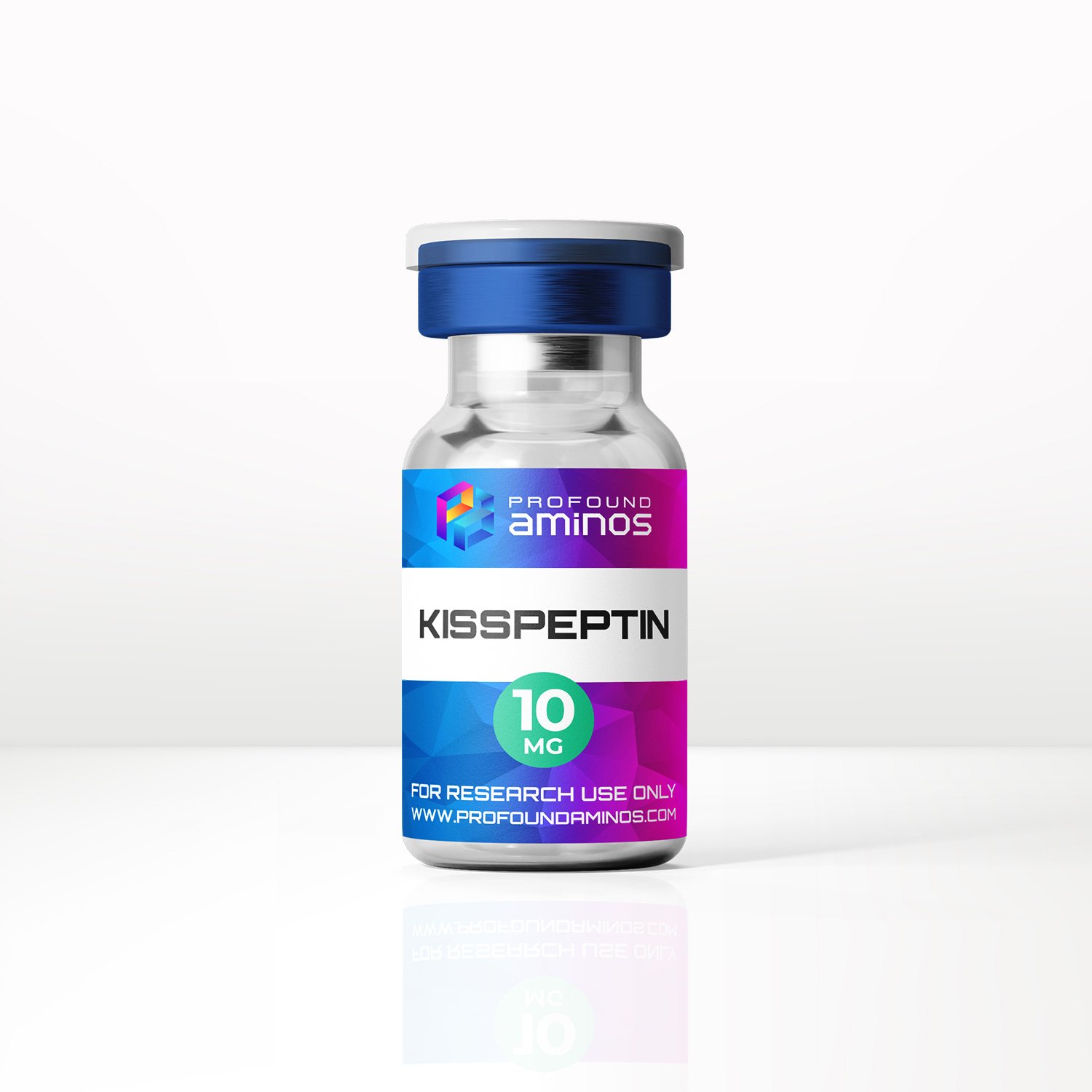
Kisspeptin
$49.00
Kisspeptin-10 (KP-10) is a synthetic decapeptide research reagent corresponding to the C-terminal active fragment of the KISS1 gene product.
Sequence: Tyr-Asn-Trp-Asn-Ser-Phe-Gly-Leu-Arg-Phe-NH₂. It is a potent, well-characterized natural ligand for the KISS1R receptor (GPR54) — a class A Gq-coupled GPCR located at chromosome 19p13.3 (NCBI Gene, updated March 2026).
Supplied as a lyophilized powder with ≥99% purity by RP-HPLC, LC-MS identity confirmation, and verified C-terminal amidation. Not for consumption, parenteral administration, or any application outside a controlled laboratory setting.
1000 in stock
Kisspeptin-10 (KP-10) | Research Reagent
TECHNICAL SPECIFICATIONS
- Product Reference : Kisspeptin-10 (KP-10) Research Reagent
- Chemical Class : Synthetic Decapeptide — KISS1 Gene Product Fragment
- Physical Format : Lyophilized Powder — Hermetically Sealed Sterile Container
- Net Reagent Content : Per sealed container (see product listing for analytical mass units)
- CAS Registry : 374675-21-5
- PubChem CID : 25240297
- Molecular Formula : C₆₃H₈₃N₁₇O₁₄
- Molecular Weight : 1302.4 Da
- Peptide Sequence : Tyr-Asn-Trp-Asn-Ser-Phe-Gly-Leu-Arg-Phe-NH₂
- Analytical Purity : ≥99% by RP-HPLC
- Identity Confirmation : LC-MS — molecular weight and sequence verified
- C-terminal : Amidation Verified — Phe-NH₂ confirmed (not free acid form)
- Counter-ion (Salt Form) : TFA salt — net peptide content stated on COA
- Endotoxin Screening : <0.25 EU (LAL assay) — see COA for batch-specific data
- Solubility : Aqueous buffer, sterile saline, 1% acetic acid (dilute)
- Storage — Lyophilized : 2–8°C, desiccated, light-protected
- Storage — In Solution : −20°C, single-use aliquots advised
- Regulatory Class : Research Use Only (RUO) — Not for administration to living organisms
- WADA Status : Prohibited List S2.2.1 — Kisspeptin and agonist analogues (note for sports research protocols)
Disclaimer : For Research Use Only (RUO). Not for human use.
Product Description
Overview :
This product comprises a KISS1 Gene Product Research Reagent supplied as a lyophilized powder for in-vitro and preclinical research applications. Kisspeptin was first identified in 1996 as a metastasis suppressor in melanoma models. Its reproductive regulatory role emerged in 2003 when two independent groups linked KISS1R loss-of-function mutations to idiopathic hypogonadotropic hypogonadism — establishing the kisspeptin system as the master upstream regulator of the hypothalamic-pituitary-gonadal (HPG) axis.
The 145-amino acid KISS1 precursor is proteolytically cleaved into four active isoforms — KP-54, KP-14, KP-13, and KP-10 — all sharing the conserved C-terminal decapeptide sequence ending in an RF-amide (Arg-Phe-NH₂). The C-terminal amidation is a biologically meaningful post-translational modification and a critical quality parameter for RUO identity confirmation.
In 2024, the first high-resolution cryo-EM structures of KISS1R in complex with KP-10 and synthetic analogues were published (PMC11328905), resolving ligand-receptor contacts at extracellular loops and characterizing both Gq and Gi coupling architectures. This structural data significantly strengthens mechanistic interpretation of in-vitro pathway readouts and informs assay selection beyond classical Ca²⁺ flux.
Research Mechanism -2026 Laboratory Applications
In 2026-era neuroendocrine and cell signaling research, Kisspeptin-10 is utilized to investigate:
1. GPR54 / KISS1R Binding & Gq Signaling : KP-10 binds KISS1R activating phospholipase C (PLC) via Gq/11, generating IP3 and DAG, triggering intracellular Ca²⁺ mobilization and PKC activation. Ki ~2.33 nM (human KISS1R), EC50 ~1.0 nM in CHO-GPR54 IP accumulation assay (PMC5790198). Research endpoints: IP1 accumulation (HTRF), Ca²⁺ flux assays (fluorometric), ERK1/2 phosphorylation panels, β-arrestin recruitment. Cryo-EM structure (PDB: 8XGS) available for docking studies.
2. HPG Axis & GnRH Pulse Regulation : KP-10 activates hypothalamic GnRH neurons driving gonadotropin secretion. Validated in heterologous KISS1R expression systems (CHO, HEK293). Research endpoints: GnRH pulse frequency assays, LH/FSH secretion kinetics in ex-vivo pituitary models, downstream steroidogenesis markers in gonadal cell cultures.
3. KISS1 Tumor Suppressor Pathway : KISS1 was identified as a metastasis suppressor via MAPK-mediated inhibition of cell motility and proliferation. KISS1R activation boosts intracellular Ca²⁺ and activates MAPKs limiting cell migration. March 2026 paper (Mol Pharm, doi:10.1021/acs.molpharmaceut.5c01853): DOTA-radiolabeled KP-10 conjugates evaluated for KISS1R-targeted radiotheranostics in triple-negative breast cancer models. Research endpoints: tumor cell migration assays, radioligand binding studies, KISS1R expression quantification.
4. Metabolic Signaling Interface : KP-10 in preclinical high-fat diet models normalized blood glucose, restored insulin-producing cell area, and increased beta-cell proliferation (Biomolecules 2025;15:1591). Ileal enteroendocrine remodeling: GLP-1 and GIP positive cell changes documented. Research endpoints: glucose tolerance assays, pancreatic islet morphology, hormone secretion panels, enteroendocrine cell quantification.
5. Cardiovascular & Hepatic Signaling : Preclinical evidence documents KISS1R activation attenuating liver steatosis and fibrosis in rodent models. KP-10 inhibits VEGF in endothelial cell models — concentration-dependent inhibition of HUVEC proliferation and migration. Research endpoints: VEGF ELISA, endothelial migration scratch assay, liver fibrosis histological scoring.
6. Granulosa Cell ERK/PI3K-Akt Pathway : July 2025 study (Domest Anim Endocrinol 2025;92:106947): kisspeptin modulates steroidogenesis via let-7b/ITGB7 axis upregulating p-ERK/ERK, p-PI3K/PI3K, and p-Akt/Akt. Research endpoints: progesterone secretion quantification, Western blot for p-ERK/Akt, flow cytometry cell cycle analysis, EdU proliferation assays.
KISS1R Structural & Identity Parameters
| Parameter | Detail |
|---|---|
| IUPAC / Common Names | Kisspeptin-10 | KP-10 | Metastin (45-54) | KISS-1 (112-121) |
| CAS Registry | 374675-21-5 |
| PubChem CID | 25240297 (Kisspeptin-10 human) |
| Molecular Formula | C₆₃H₈₃N₁₇O₁₄ |
| Molecular Weight | 1302.4 Da |
| Peptide Sequence | Tyr-Asn-Trp-Asn-Ser-Phe-Gly-Leu-Arg-Phe-NH₂ (YNWNSFGLRF-NH₂) |
| C-terminal Modification | Amidation (Phe-NH₂) — critical for KISS1R activation |
| Active Motif | C-terminal RFamide decapeptide — conserved across KP isoforms |
| Receptor Target | KISS1R (GPR54) — Gq/11-coupled class A GPCR | Chr 19p13.3 |
| KISS1 Gene Locus | Chromosome 1q32.1 (NCBI Gene, updated March 3, 2026) |
| Cryo-EM Structure | PDB: 8XGS (KISS1R-Gq complex with KP-10, 2024) |
| Ki (Human KISS1R) | ~2.33 nM (radioligand binding, Tocris reference data) |
| IP Pathway EC50 | ~1.0 nM (CHO-GPR54 cells, PMC5790198) |
| Isoform Family | KP-54, KP-14, KP-13, KP-10 — all share this C-terminal sequence |
MOLECULAR STRUCTURE
Chemical structure of Kisspeptin-10 (KP-10)
1)
2D chemical structure of Kisspeptin-10 (KP-10) research reagent, PubChem CID 25240297, showing the critical C-terminal amidation for in-vitro laboratory studies.

2)
3D molecular conformation of Kisspeptin-10 synthetic decapeptide, CAS 374675-21-5, illustrating the active fragment for preclinical KISS1R receptor binding research.

COMPARATIVE RESEARCH CONTEXT : KP-10 ISOFORM LANDSCAPE
| Parameter | KP-10 | KP-14 | KP-13 | KP-54 |
|---|---|---|---|---|
| Amino Acid Length | 10 | 14 | 13 | 54 |
| CAS (Human) | 374675-21-5 | Not widely assigned | Not widely assigned | Not widely assigned |
| PubChem CID | 25240297 | Varies by salt form | Varies by salt form | Varies by salt form |
| KISS1R Potency | High — most studied | High | High | Full agonist (longest) |
| Common Assay Use | Receptor pharmacology, metabolic, oncology | Reproductive neuroendocrine models | Reproductive models | Neuroendocrine infusion studies |
| 2026 New Data | Radiotheranostics TNBC (Mar 2026) | AlphaFold 3 analogs (Feb 2026) | Limited | Limited | Extended analog development |
| Salt Form / COA | TFA salt — net peptide content required | TFA salt | TFA salt | TFA salt |
| RUO Availability | Widely available USA | Limited | Limited | Available |
WHY SOURCE FROM PROFOUND AMINOS
1-C-terminal Amidation Verification — Not Just Sequence
The Phe-NH₂ C-terminal amide is not cosmetic — it is functionally critical. The free acid form (Phe-OH), which can result from incomplete amidation during synthesis, shows significantly reduced KISS1R binding affinity. Standard HPLC purity and even mass alone cannot distinguish amidated from free-acid forms at low contamination levels. Our analytical protocol explicitly verifies C-terminal amidation status by LC-MS fragmentation — a step that protects binding assay validity from the start.
2-Net Peptide Content Stated Explicitly
Kisspeptin-10 is commonly supplied as a TFA (trifluoroacetate) salt. Without explicit net peptide content, researchers cannot calculate accurate molar concentrations from labeled weight — introducing
systematic error across every assay point. Our COA states net peptide content separately from gross weight, aligned to the consensus Clinical Chemistry guidance on peptide characterization for research (PMC4830481). This is standard practice at major academic suppliers and should be non-negotiable for any serious laboratory sourcing.
3-Cold-Chain Integrity — USA Domestic Dispatch
KP-10 contains tryptophan and tyrosine residues sensitive to photodegradation and oxidative modification. Shipments from international manufacturers introduce uncontrolled temperature and light exposure during customs transit. Our reagents ship exclusively within the USA via a monitored cold-chain protocol from a climate-controlled facility — eliminating the degradation variables that compromise assay reproducibility before the product even reaches your bench.
REGULATORY & COMPLIANCE STATEMENT (RUO)
FOR RESEARCH USE ONLY. NOT FOR HUMAN OR ANIMAL APPLICATION.
- Regulatory Status : Regulatory Status Research Use Only (RUO) — U.S. Federal Framework
- FDA Status : No FDA-approved Kisspeptin-10 product exists. Investigational stage only.
- RUO Intended Use : In-vitro KISS1R binding and signaling assays, neuroendocrine pathway research, metabolic model studies, oncology cell migration assays, radiotheranostic probe development
- Not a Drug : Not evaluated by FDA for safety or efficacy in any clinical application
- Not a Supplement : Not a dietary supplement, nutraceutical, or consumer product
- WADA Classification : Prohibited List S2.2.1 (Testosterone-Stimulating Peptides). Sports research protocols require institutional review.
- Google Ads Policy : January 7, 2026 update: peptide/pharmaceutical suppliers permitted in USA under specific certification. Content must remain research-context only with no outcome claims.
- PPE Required : Gloves, lab coat, protective eyewear during reconstitution
- CAS Safety Sheet : CAS 374675-21-5 — refer to SDS before use
STRICT PROHIBITION : Promoting, distributing, or using this research reagent for any application involving administration to living organisms is strictly prohibited under U.S. federal law. FDA warning letters (2024–2025) confirm RUO labeling does not shield products from drug-misbranding enforcement where marketing implies use in living organisms.
These statements have not been evaluated by the Food and Drug Administration. This product is not intended to diagnose, treat, cure, or prevent any disease.
Frequently Asked Questions
Q1: Is Kisspeptin-10 intended for consumption or administration?
A: No. Kisspeptin-10 is strictly classified as a Research Use Only (RUO) reagent. It is not approved, labeled, or intended for consumption, parenteral administration, or any diagnostic application. Purchase confirms institutional laboratory research use only.
Q2: What is the difference between KP-10, KP-14, KP-13, and KP-54?
All four are proteolytic cleavage products of the same KISS1 gene precursor. They share the conserved C-terminal decapeptide (the KP-10 sequence) and the RF-amide terminus essential for KISS1R activation. KP-10 is the shortest active fragment and the most widely used in cell-based receptor pharmacology because it provides a clean, defined agonist signal at well-characterized potency. KP-54 is the predominant circulating form in humans and is used in neuroendocrine studies where sustained receptor stimulation is being modeled. For most in-vitro binding and signaling assays, KP-10 is the standard.
Q3: Why does C-terminal amidation matter for KISS1R assays?
The Phe-NH₂ amide at the C-terminus is structurally required for high-affinity KISS1R engagement. The corresponding free acid form (Phe-OH) shows significantly reduced receptor binding affinity in published pharmacology data. Because TFA salt synthesis occasionally yields incomplete amidation, verifying amidation by LC-MS fragmentation before use is important for assay validity. This is why our COA explicitly states amidation status — not just mass and purity.
Q4: What analytical data is included with each batch?
Every batch COA includes: (1) RP-HPLC purity ≥99%, (2) LC-MS molecular weight and sequence confirmation, (3) C-terminal amidation verification, (4) salt form and net peptide content (not gross weight), (5) endotoxin screening <0.25 EU (LAL assay), (6) lot number and manufacturing date. Available for download per batch.
Q5: What cell systems are validated for KISS1R research with KP-10?
The most widely used systems in published literature: CHO cells stably expressing GPR54/KISS1R for IP accumulation and dose-response benchmarking (EC50 ~1.0 nM, PMC5790198); HEK293 cells overexpressing KISS1R for Ca²⁺ flux and ERK phosphorylation (PMC12112028); immortalized hypothalamic neuron lines (GT1-7) for GnRH-relevant pathway work. The 2024 cryo-EM structure (PDB: 8XGS) is also now available for in-silico docking and structure-guided assay design.
Q6: What is the FDA regulatory status?
No FDA-approved Kisspeptin-10 drug product exists in the USA. The FDA’s RUO guidance (IVD Products Labeled for Research Use Only) states that RUO labeling is intended to prevent use in clinical diagnosis, and that products should not be labeled RUO if intended for clinical diagnostic use. This product is supplied strictly as a laboratory research reagent under the RUO framework — no therapeutic or diagnostic claims are made.
Q7: Why is KP-10 on the WADA prohibited list?
WADA added kisspeptin and agonist analogues to the Prohibited List under S2.2.1 (Testosterone-Stimulating Peptides in Males) because KISS1R activation drives GnRH release, which in turn stimulates pituitary LH/FSH and downstream gonadal testosterone production. This constitutes indirect androgen pathway stimulation. Researchers studying kisspeptin in any sports-related protocol context should account for this classification in their institutional and ethical review documentation.
Q8: What are the most significant 2025–2026 research developments?
March 2026 (Mol Pharm): DOTA-radiolabeled KP-10 conjugates evaluated for KISS1R-targeted radiotheranostics in triple-negative breast cancer — first systematic radiotheranostic study. February 2026 (bioRxiv): bioengineered extended half-life kisspeptin fusions (HSK-1, HSK-2) modeled with AlphaFold 3 in complex with KISS1R showing maintained receptor engagement. November 2025 (Biomolecules): KP-10 normalizes metabolic phenotype in high-fat diet rodent models with documented beta-cell proliferation. May 2025 (Int J Mol Sci): comprehensive KISS1R agonist-antagonist review with validated assay comparison table.
Q9: Can Kisspeptin-10 be used outside a controlled laboratory research setting?
A: Absolutely not. This reagent is classified strictly for in-vitro and preclinical laboratory investigation. Any non-laboratory use violates our Terms of Service and will result in immediate order cancellation. FDA warning letters (2024–2025) confirm that RUO labeling does not protect against drug-misbranding enforcement when marketing implies use in living organisms.
Q10: How does KP-10 relate to metabolic and GLP-1 research intersections?
Published preclinical literature documents a functional interface between kisspeptin and incretin signaling. The November 2025 study (Biomolecules) shows KP-10 modulating GLP-1 and GIP positive enteroendocrine cells in the ileum alongside metabolic normalization. This positions kisspeptin research at an emerging intersection with GLP-1 pathway biology. All documented observations are from preclinical animal models and do not constitute clinical evidence.
KEY REFERENCES : PubMed & Authoritative Sources (2024–2026)
| # | Citation | Relevance |
|---|---|---|
| 1 | Tas H et al. Mol Pharm 2026. doi:10.1021/acs.molpharmaceut.5c01853 | KISS1R radiotheranostics TNBC March 2026 , latest data |
| 2 | bioRxiv 2026. doi:10.64898/2026.02.04.703727 | Extended half-life KP analogs — AlphaFold 3 , Feb 2026 |
| 3 | PMC11328905 — Nat Struct Mol Biol 2024 | Cryo-EM KISS1R-Gq complex with KP-10 , structural benchmark |
| 4 | Biomolecules 2025;15(11):1591 | KP-10 metabolic normalization in HFD model , Nov 2025 |
| 5 | Int J Mol Sci 2025;26(10):4890 | KISS1/KISS1R agonist-antagonist comprehensive review , May 2025 |
| 6 | Domest Anim Endocrinol 2025;92:106947 | KP-10 granulosa cell ERK/PI3K-Akt signaling , Jul 2025 |
| 7 | PMC5790198 — Endocrinology 2018 | CHO-GPR54 IP assay EC50 ~1.0 nM , potency reference |
| 8 | PMC12112028 — 2025 | HEK293 KISS1R signaling assay validation |
| 9 | Oakley AE et al. Endocr Rev 2009;30(6):713 | Kisspeptin signaling in the brain , primary authority |
| 10 | Kotani M et al. J Biol Chem 2001;276(37):34631 | KISS1 encodes natural GPR54 ligands , discovery paper |
| 11 | NCBI Gene: KISS1 (3814) — Updated March 3, 2026 | Gene annotation, isoforms, chromosome 1q32.1 |
| 12 | NCBI Gene: KISS1R (84634) — Updated March 3, 2026 | Receptor annotation — chromosome 19p13.3 |
| 13 | FDA RUO/IUO Guidance Document | RUO labeling legal framework — intended use doctrine |
| 14 | Google Ads Policy — Jan 7, 2026 update | Pharmaceutical suppliers policy — USA peptide content rules |
| Weight | 0.02 lbs |
|---|---|
| Dimensions | 1.5 × 2.75 × 1 in |
| Strength |
10mg |
DISCLAIMER:
- Products sold on our website are meant for scientific research purposes only, designed for in vitro testing and lab experimentation exclusively. These products are not intended to be used as foods, drugs or cosmetics, any sort of bodily introduction of the products into humans or animals is strictly prohibited. They must also not be misbranded, misused, or mislabeled, or used for anything other than research and scientific investigation.
- All the products you see on the website are being sold in a lyophilized powder state (freeze-dried), in a sealed sterile vial; and should be reconstituted.
The product’s label clearly states the amount of product a vial contains; some products are offered in different variations. - The products we are selling come in a sealed vial but require additional lab equipment for proper testing.
- Though we make sure packaging, label, seals and writing does not differ from the product photos you see on our website, there is a chance for a minimal deviation.
Frequently bought together: Melanotan 1, 10ml Vial Storage Case, Sterile Water
Related products
Research Compounds
Research Compounds
Research Compounds
Research Compounds