
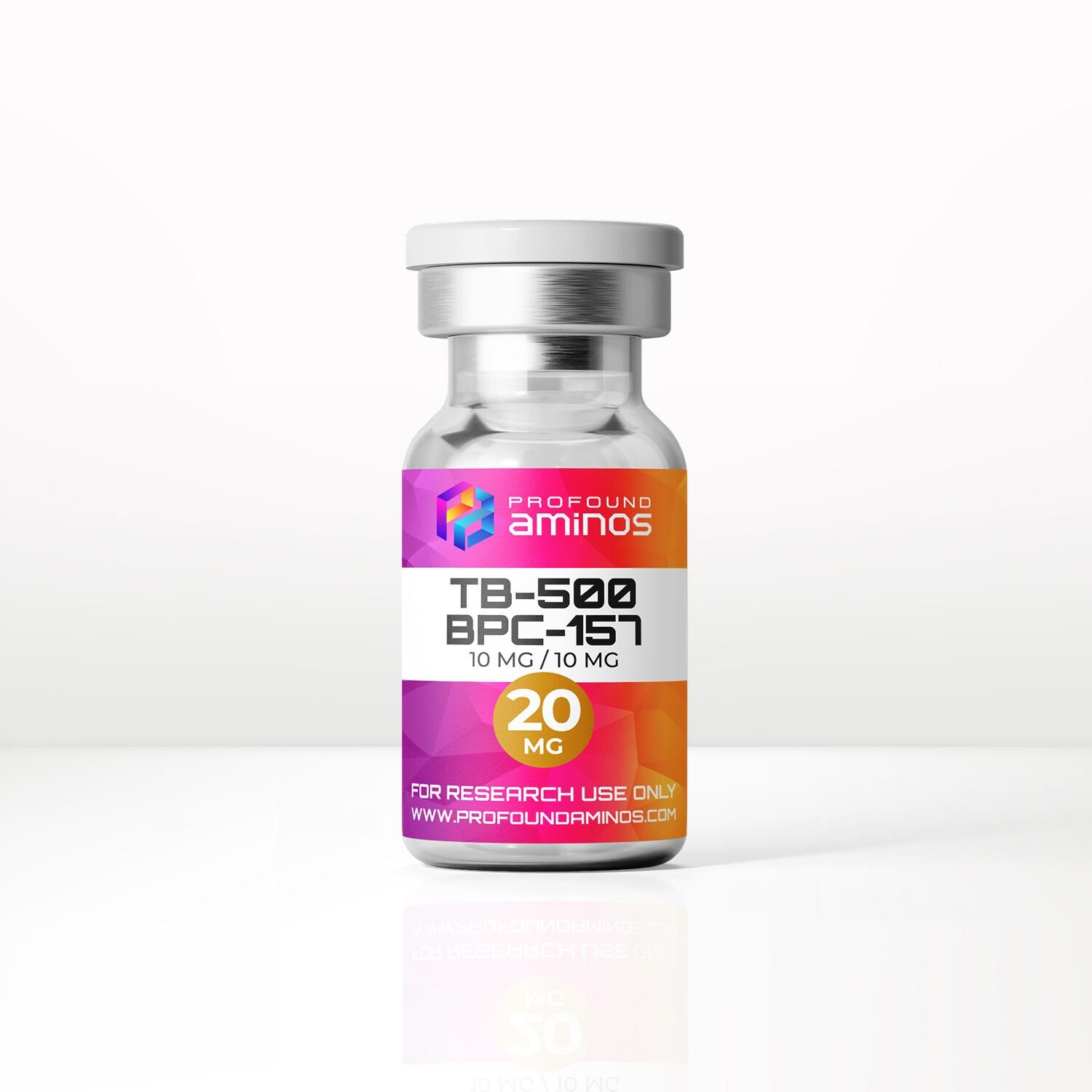
TB-500/BPC-157 20mg
$139.00
A high-potency, dual-peptide system combining 10mg BPC-157 and 10mg TB-500 in a single lyophilized vial. Engineered for high-throughput laboratory research requiring elevated concentration gradients. Format: Lyophilized Cake (Stable Powder) Concentration: High (20mg Total) Grade: Research Reagent (>99% Purity)
1000 in stock
BPC-157 TB-500 (20mg) | High-Concentration Research Blend
TECHNICAL SPECIFICATIONS ( Research Blend)
- Total Content: 20mg (10mg BPC-157 + 10mg TB-500).
- Appearance: White lyophilized solid (Compressed Cake/Pellet).
- Solubility: High stability in Bacteriostatic Water.
- Storage: -20°C (Freezer) for long-term stability.
Disclaimer : For Research Use Only (RUO). Not for human use.
Product Overview
The High-Concentration Matrix The 20mg Precision Blend is our most potent research formulation, specifically calibrated for High-Throughput Research and laboratories conducting an extensive series of experiments.
Unlike standard low-dose formats, this 20mg Vial allows researchers to prepare high-molarity stock solutions from a single source, minimizing handling errors and ensuring consistency across multiple trial phases.
Why Choose the 20mg Format?
- Efficiency for Large Protocols : Ideal for long-duration studies where multiple substrate applications are required.
- Cost-Effective Scaling : Provides a higher volume of active reagent for laboratories operating on strict budgets.
- Dual-Pathway Synergy : – BPC-157 (10mg): Investigated for its influence on the Nitric Oxide (NO) system and angiogenic signaling. – TB-500 (10mg): Studied for its role in Actin sequestration and cytoskeletal organization.
Chemical Identity & Mechanism (BPC-157 TB-500 20mg)
1. BPC 157: The “Angiogenic Primer.”
BPC 157 (Pentadecapeptide) acts by modulating the nitric oxide synthase (NOS) pathway.
Action : It activates the VEGF/VEGFR2-Akt-eNOS signaling axis, thereby “priming” tissue for repair by improving blood flow and upregulating early growth response gene 1 (EGR-1).
2. TB500: The “Structural Mobilizer.”
TB-500 is a fragment derived from thymosin beta-4, and its primary role is actin sequestration.
Action : By modulating actin polymerization specifically the G-actin to F-actin balance TB-500 enables cells to alter their morphology and migrate toward sites of injury. In this way, it supplies the “structural support” that complements the repair signaling attributed to BPC-157.
3. The Synergistic Effect
Some recent reviews published in 2026 propose that these mechanisms may be complementary: BPC-157 is described as supporting fibroblast viability under stress, whereas TB-500 is described as promoting fibroblast migration together, in theory, accelerating extracellular matrix (ECM) remodeling.
Chemical Structures (BPC-157 TB-500)
Chemical Structure of BPC 157 (Pentadecapeptide)
2D chemical structure diagram of BPC-157 (pentadecapeptide), CAS 137525-51-0 -research-grade peptide intended for angiogenesis pathway studies.
Molecular structure of BPC-157: a synthetic pentadecapeptide (15 amino acids) derived from human gastric juice (sequence begins Gly-Glu-Pro-Pro-Pro…). Source: PubChem CID 9941957.
Chemical Structure of TB500 Fragment (Ac-LKKTETQ)
2D chemical structure of the TB-500 fragment (Ac-LKKTETQ), CAS 885340-08-9 – an active fragment associated with actin-binding/actin dynamics research (thymosin beta-4-derived).
Molecular structure of TB-500 (a PubChem-listed thymosin beta-4 fragment). Its active 7-amino acid sequence (Ac-LKKTETQ) is commonly cited as the motif associated with cell migration in mechanistic discussions. Source: PubChem CID 16132341.
Regulatory Status : Research Use Only (RUO). Not for human consumption, diagnostic, or clinical use.
Comparative Research Context : BPC-157 TB-500
Direct Comparison: The Research Matrix
| Feature | BPC157 TB500 (Blend) | TB500 (Mono) | BPC 157 (Mono) |
|---|---|---|---|
| Target Pathway | Dual: Angiogenic + Cytoskeletal | Actin Polymerization | VEGF / Nitric Oxide Axis |
| Complexity | High (Multi-Variable Analysis) | Moderate (Single Variable) | Moderate (Single Variable) |
| Mechanism Profile | Co-Activation (Synergistic) | Structural Reorganization | Angiogenic Signaling |
| Analytical Focus | Synergistic Signaling Assays | Cell Migration & Motility Assays | Endothelial Modulation Studies |
Why Researchers source from PROFOUND AMINOS
1. The “Wolverine” Synergy (Scientific Context):
While the “Wolverine Stack” is a cultural label for rapid recovery, its proposed scientific rationale is based on complementary actions: BPC-157 is framed as influencing gene-level repair programs through growth-factor related modulation, whereas TB-500 is framed as supporting structural aspects of cell motility via actin regulation.
Our Standard : We use co-lyophilization to deliver these two distinct mechanisms in a precise, predefined ratio, reducing mixing variability and helping avoid measurement errors that can occur with manual preparation.
2. USA Cold-Chain Logistics (Growth)
Both peptides are sensitive to thermal degradation.
The Risk : International shipments can arrive with reduced integrity when exposed to elevated temperatures in transit.
Our protocol: inventory is maintained at −20 °C and dispatched with active cold packs to help preserve peptide-chain integrity during shipping, rather than material that has undergone heat-related degradation.
3. “Triple G” Compliance
We maintain rigorous federal-compliance standards as of 2026 and avoid using full pharmaceutical brand names to respect trademark protections. All referenced information is drawn from peer-reviewed literature, including sources such as the Journal of Orthopaedic Research.
REGULATORY & COMPLIANCE STATEMENT
Classification : Research Use Only (RUO). Not for human consumption, cosmetic, diagnostic, or clinical use.
FDA Warning: BPC 157 is classified as a Category 2 Bulk Drug Substance. It is not approved for the treatment of any disease (injury, inflammation) in humans.
WADA Warning: Both BPC-157 TB-500 are banned by the World Anti-Doping Agency (WADA) under “Peptide Hormones, Growth Factors, Related Substances, and Mimetics.” Athletes are strictly prohibited from using these compounds.
Handling : Wear nitrile gloves. Refer to the Safety Data Sheet (SDS) for CAS 137525-51-0 and 885340-08-9.
Frequently Asked Questions
Q1: Why combine BPC-157 and TB-500 in a single blend?
A: Complementary action. The research literature commonly frames these peptides as influencing different, potentially rate-limiting components of tissue-repair biology. BPC-157 is discussed primarily in the context of signaling modulation (e.g., NO- and VEGF-associated pathways) that may support microenvironmental conditions such as perfusion and cellular stress responses, whereas TB-500 is discussed mainly in terms of cytoskeletal mechanics (actin dynamics) that can facilitate cell shape change and migration. A combined blend is therefore positioned to address both biochemical signaling and structural/migratory processes involved in recovery without implying clinical outcomes.
Q2: Is TB-500 the same as thymosin beta-4?
A: No, though they’re related. Thymosin beta-4 is a 43-amino acid peptide, whereas TB-500 typically refers to a synthetic fragment (commonly residues 17-23, sequence Ac-LKKTETQ) that includes a key actin-interacting motif. Our blend uses this active fragment so studies can focus on the core functional region without working with the full-length peptide.
Q3: What are the primary safety and handling precautions?
A: Follow standard GLP-aligned laboratory practices. Because this material is a high-purity organic reagent, appropriate PPE (e.g., gloves, eye protection, lab coat) should be used at all times. Handle both the lyophilized material and any reconstituted solution in a controlled setup (e.g., a laminar flow hood) to minimize aerosol generation and reduce the risk of inhalation or skin/eye contact. This material is intended only for controlled laboratory research/analytical use and must be handled and disposed of in accordance with institutional chemical-safety procedures.
Q4: How should this blend be reconstituted for research?
A: A sterile, bacteriostatic aqueous diluent (USP-grade) is commonly used as a vehicle in laboratory protocols. BPC-157 is frequently described as aqueously compatible and has been reported as stable under acidic conditions, while TB-500 is generally considered water-soluble. Add the diluent slowly along the vial wall and avoid vigorous shaking; instead, use gentle swirling to limit foaming and mechanical shear, which can affect peptide integrity.
| Strength |
10mg |
|---|
DISCLAIMER:
- Products sold on our website are meant for scientific research purposes only, designed for in vitro testing and lab experimentation exclusively. These products are not intended to be used as foods, drugs or cosmetics, any sort of bodily introduction of the products into humans or animals is strictly prohibited. They must also not be misbranded, misused, or mislabeled, or used for anything other than research and scientific investigation.
- All the products you see on the website are being sold in a lyophilized powder state (freeze-dried), in a sealed sterile vial; and should be reconstituted.
The product’s label clearly states the amount of product a vial contains; some products are offered in different variations. - The products we are selling come in a sealed vial but require additional lab equipment for proper testing.
- Though we make sure packaging, label, seals and writing does not differ from the product photos you see on our website, there is a chance for a minimal deviation.
Frequently bought together: GA Water for AOD-9604, SS-31, CJC 1295 with DAC 5mg
Related products
Research Compounds
Research Compounds