Klow
$119.00
This is an 80mg Multi-Pathway Research Reagent designed strictly for laboratory investigation of regenerative signaling pathways.
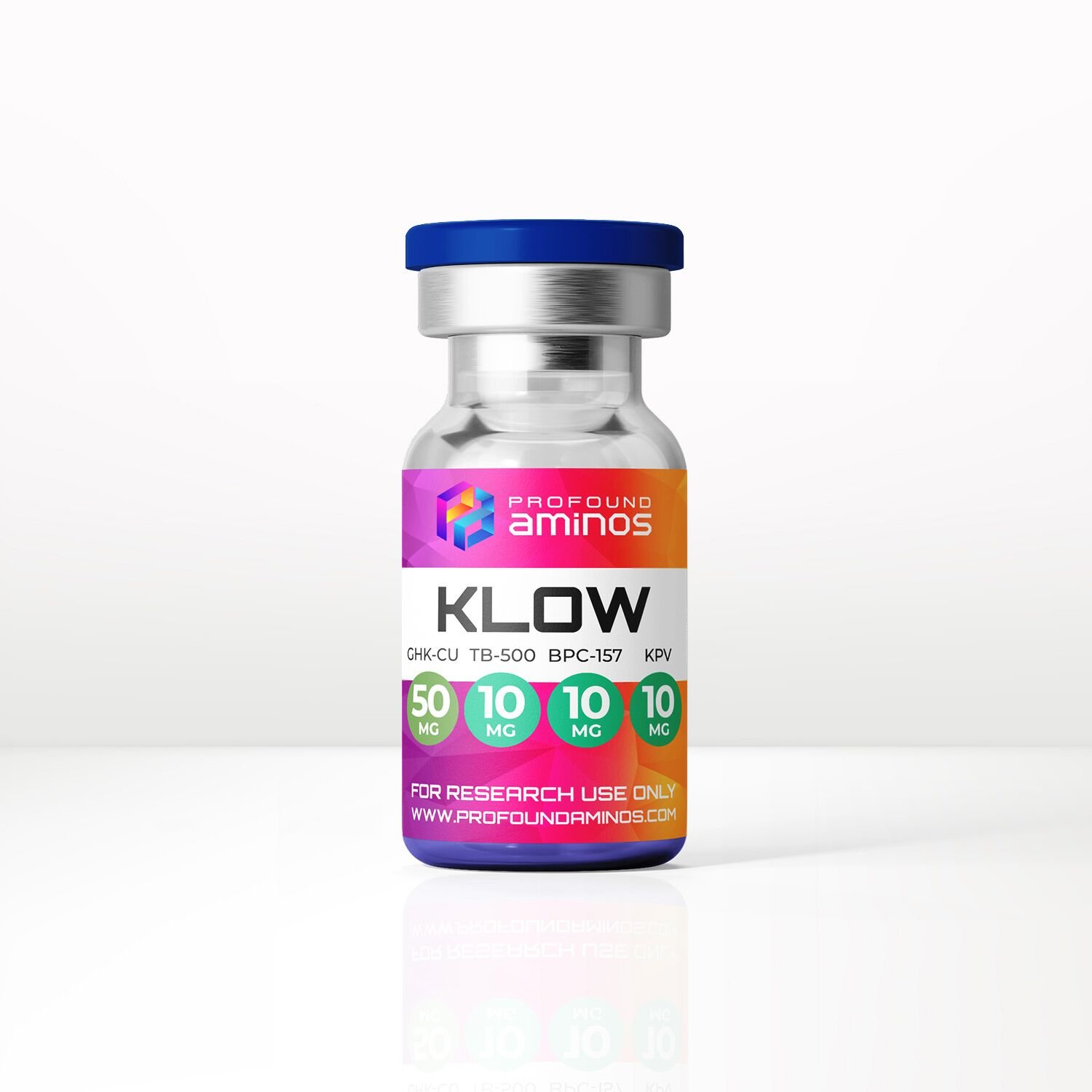
It features a lyophilized blend of four scientifically characterized peptide components ,GHK-Cu (50mg), BPC-157 (10mg), TB-500 (10mg), and KPV (10mg) – each targeting a distinct biological pathway.
This formulation enables researchers to investigate simultaneous multi-pathway effects in a single, standardized reagent batch. Not for consumption, parenteral administration, or any application outside a controlled laboratory setting.
1000 in stock
KLOW Peptide Blend GHK-Cu (50mg) + BPC-157 (10mg) + TB-500 (10mg) + KPV (10mg)
TECHNICAL SPECIFICATIONS
- Product Reference : KLOW Multi-Peptide Research Reagent
- Chemical Class : Heterogeneous Peptide Reagent Blend
- Physical Format : Lyophilized Powder Hermetically Sealed Sterile Container
- Net Reagent Content : 80 (mass units) total lyophilized peptide content
- Reagent Fraction 1 : GHK-Cu
- CAS Registry : 89030-95-5
- PubChem CID : 378611
- Molecular Formula : C₁₄H₂₃CuN₆O₄
- Fraction Content : 50 mass units
- Reagent Fraction 2 : BPC-157
- CAS Registry : 137525-51-0
- PubChem CID : 9941957
- Molecular Formula : C₆₂H₉₈N₁₆O₂₂
- Fraction Content : 10 mass units
- Reagent Fraction 3 : TB-500 (Ac-LKKTETQ)
- CAS Registry : 77591-33-4
- Sequence Class : Acetylated Heptapeptide
- Fraction Content : 10 mass units
- Reagent Fraction 4 : KPV (Lys-Pro-Val)
- CAS Registry : 69630-60-0
- PubChem CID : 122130
- Fraction Content : 10 mass units
- Analytical Purity : ≥99% (RP-HPLC per fraction)
- Identity Confirmation : LC-MS All four fractions verified
- Endotoxin Screening : <0.25 EU (LAL method)
- Reconstitution Buffer : Aqueous laboratory buffer / bacteriostatic-grade solvent
- Storage Lyophilized : 2–8°C, desiccated, light-protected
- Storage Reconstituted : −20°C, single-use aliquots advised
- Regulatory Class : Research Use Only (RUO) Not for administration to living organisms
Disclaimer : For Research Use Only (RUO). Not for human use.
Product Description
Overview :
This product comprises an 80mg Multi-Component Peptide Reagent known as KLOW Blend. It combines four individual research-grade peptide components, each with documented preclinical bioactivity in extracellular matrix remodelling, vascular signalling, actin-mediated cytoskeletal dynamics, and inflammatory pathway modulation.
Unlike single-compound reagents limited to one mechanistic endpoint, KLOW’s multi-pathway architecture enables researchers to study how four complementary biological systems interact simultaneously making it uniquely valuable for comprehensive regenerative biology assay design.
Research Mechanism : Laboratory Applications
In 2026-era regenerative research, this reagent blend is utilized to study:
1. ECM Remodeling & Collagen Synthesis : Investigating how GHK-Cu modulates extracellular matrix reconstruction via collagen I/III upregulation and glycosaminoglycan deposition in fibroblast culture models.
2. Angiogenesis & Vascular Signaling : Examining how BPC-157 activates the VEGFR2/Akt-eNOS axis and FAK/paxillin pathway to study endothelial cell migration and vascular tube formation in in-vitro assays.
3. Actin-Mediated Cytoskeletal Dynamics : Studying how TB-500’s LKKTET actin-binding domain modulates G-actin sequestration and cytoskeletal organization in scratch-wound closure assay models.
4. NF-κB Pathway Inhibition : Quantifying how KPV (Lys-Pro-Val) blocks p65/RelA nuclear translocation via competitive importin-α3 binding, suppressing pro-inflammatory cytokine secretion at nanomolar concentrations in cell-based reporter assays.
MOLECULAR STRUCTURE
Component 1: GHK-Cu
GHK-Cu is a naturally occurring copper complex of the tripeptide glycyl-L-histidyl-L-lysine (formula C₁₄H₂₃CuN₆O₄). The Cu²⁺ ion is coordinated by the imidazole nitrogen of histidine, the alpha-amino group of glycine, and the deprotonated amide nitrogen forming a highly stable complex with log stability constant 16.44. Research applications include fibroblast collagen synthesis assays, ECM remodelling studies, and antioxidant pathway investigation via superoxide dismutase upregulation.
Component 2: BPC-157
BPC-157 is a synthetic 15-amino acid peptide (C₆₂H₉₈N₁₆O₂₂) derived from a gastric cytoprotective sequence. It activates endothelial nitric oxide synthase (eNOS) via the VEGFR2/Akt axis and modulates FAK/paxillin cytoskeletal signaling. Published preclinical literature documents VEGF-mediated vascular tube formation, endothelial migration metrics, and nitric oxide pathway upregulation in rodent and cell models. A 2025 systematic review (PMC12313605) identified 36 preclinical studies demonstrating consistent mechanistic activity across tendon, ligament, and vascular repair endpoints.
Component 3: TB-500
TB-500 is a synthetic acetylated heptapeptide (Ac-Lys-Lys-Thr-Glu-Thr-Gln-Glu) corresponding to amino acids 17–23 of thymosin β-4. Its LKKTET actin-binding domain modulates G-actin sequestration and cytoskeletal dynamics, enabling cell migration in scratch-wound assay models. Research endpoints include fibroblast motility measurement, VEGF expression changes, and anti-fibrotic gene expression quantification. A 2024 analytical chemistry study (Front Endocrinol 2021;12:767785) developed validated methods for TB-500 quantification in in-vitro and rodent model matrices.
Component 4: KPV
KPV (Lys-Pro-Val) is the C-terminal tripeptide fragment of alpha-melanocortin (α-MSH). At nanomolar concentrations it competitively blocks the interaction between importin-α3 (Imp-α3) and the p65/RelA subunit of NF-κB, preventing nuclear translocation in activated cells. This mechanism operates independently of melanocortin receptor binding. Published research includes intestinal epithelial cell models (Gastroenterology 2008, PMID:18061177), PepT1-mediated uptake studies (PMC2431115), and a 2025 Tissue & Cell study demonstrating MAPK/NF-κB suppression in fine-dust-exposed keratinocyte models (doi:10.1016/j.tice.2025).
Comparative Research Context :
Table 1: Peptide Reagent Landscape
| Feature | KLOW Blend | GLOW Blend | BPC-157 Mono | GHK-Cu Mono |
|---|---|---|---|---|
| Components | 4 peptides | 3 peptides | 1 peptide | 1 peptide |
| ECM Remodeling | GHK-Cu 50mg | GHK-Cu | No | Yes |
| Vascular Signaling | BPC-157 10mg | BPC-157 | Yes | No |
| Actin / Cell Migration | TB-500 10mg | TB-500 | No | No |
| NF-κB Inhibition (KPV) | KPV 10mg | Not Included | No | No |
| MAPK Suppression | Dual pathway | Partial only | Partial only | No |
| Total Mass per Vial | 80mg | 70mg | 10mg | 50mg |
| Pathways Targeted | 4 simultaneous | 3 pathways | 1 pathway | 1 pathway |
KEY DIFFERENTIATOR: KPV is the component that distinguishes KLOW from GLOW. It provides NF-κB inhibition via competitive importin-α3 binding and MAPK suppression directly controlling inflammatory pathway interference during study conditions. GLOW does not address this pathway.
WHY SOURCE FROM PROFOUND AMINOS
1. Four-Component Sequence Integrity Verification
A standard purity test confirms what percentage of a vial is peptide it does not confirm which peptide. KLOW contains four chemically distinct compounds. We verify each component individually via Mass Spectrometry (LC-MS), confirming molecular weight, sequence integrity, and identity for all four peptides before batch release. Purity without identity confirmation is an incomplete quality standard.
2. Single-Batch Homogeneity – The Research Reproducibility Advantage
Pooling individual peptide vials from separate sources introduces inter-batch variance that compromises assay reproducibility. Our KLOW 80mg format is blended at a fixed molar ratio (GHK-Cu 50mg : BPC-157 10mg : TB-500 10mg : KPV 10mg) in a single lyophilization run. Every aliquot a researcher prepares from this vial contains an identical ratio of all four components improving R-squared values across experimental replicates.
3. Cold-Chain Integrity -USA Domestic Shipping
Peptide reagents are thermally sensitive. International sourcing introduces uncontrolled temperature excursions during customs transit. KLOW ships exclusively within the USA via a monitored cold-chain logistics protocol from a climate-controlled facility directly to your research address eliminating degradation risks inherent to overseas peptide sourcing.
REGULATORY & COMPLIANCE STATEMENT (RUO)
FOR RESEARCH USE ONLY. NOT FOR HUMAN OR ANIMAL APPLICATION.
- Regulatory Status : Research Use Only (RUO) U.S. Federal Regulatory Framework
- FDA Status : Not approved. All 4 components are FDA Category 2 bulk substances (Sept 2023)
- Not a Drug : Not evaluated by FDA for safety or efficacy in any application
- Not a Supplement : Not a dietary supplement, nutraceutical, or consumer product
- Chemical Reference : Supplied solely for in-vitro testing and preclinical laboratory investigation
- PPE Required : Gloves, lab coat, protective eyewear during reconstitution and handling
- CAS Safety Sheets : GHK-Cu: 89030-95-5 · BPC-157: 137525-51-0 · TB-500: 77591-33-4 · KPV: 69630-60-0
STRICT PROHIBITION : Promoting, distributing, or using this research reagent for any application involving administration to living organisms is strictly prohibited and constitutes a violation of U.S. federal law. This product is not manufactured, labeled, or intended for any pharmaceutical, therapeutic, or clinical application.
These statements have not been evaluated by the Food and Drug Administration. This product is not intended to diagnose, treat, cure, or prevent any disease.
Frequently Asked Questions
Q1: Is KLOW peptide blend intended for consumption or administration?
A: No. KLOW is strictly classified as a Research Use Only (RUO) reagent. It is not approved, labeled, or intended for consumption, parenteral administration, therapeutic use, or any diagnostic application. Purchase confirms agreement to institutional laboratory research use only.
Q2: What does the 80mg format mean?
The 80mg refers to total lyophilized peptide content across all four components: GHK-Cu (50mg) + BPC-157 (10mg) + TB-500 (10mg) + KPV (10mg). The blend ratio is fixed at manufacture, ensuring uniform molar composition across all reconstituted aliquots from a single batch.
Q3: How do I reconstitute KLOW for laboratory use?
KLOW is soluble in bacteriostatic water or sterile PBS buffer. Researchers must calculate the target molar concentration for their specific assay protocol before adding solvent. Reconstitute slowly using a swirling motion do not vortex peptide solutions.
Q4: Can reconstituted KLOW solution be stored?
Yes. Once reconstituted, aliquot immediately into working volumes and store at −20°C. Avoid repeated freeze-thaw cycles, which accelerate peptide degradation and compromise assay reproducibility. Single-use aliquots are recommended.
Q5: What makes KLOW different from GLOW blend?
KLOW contains KPV (Lys-Pro-Val) a tripeptide not present in GLOW. KPV directly inhibits NF-κB nuclear translocation via competitive importin-α3 binding, suppressing pro-inflammatory cytokine secretion in cell-based models. This adds a fourth mechanistic pathway inflammatory signaling modulation that GLOW does not address.
Q6: What is the FDA regulatory status of KLOW components?
All four KLOW components GHK-Cu, BPC-157, TB-500, and KPV are unapproved drug substances with no FDA-approved therapeutic indication. In September 2023, FDA designated all four as Category 2 bulk drug substances presenting significant safety risk under sections 503A/503B of the FD&C Act. KLOW is sold exclusively as a research chemical under the RUO regulatory framework.
Q7: Does KLOW have published clinical trial data?
No peer-reviewed studies have evaluated the KLOW formulation as a whole. Component-level research includes: a 2025 systematic review of BPC-157 across 36 preclinical studies (PMC12313605); a 2024 BioImpacts review of GHK-Cu ECM modulation (PMID:39963574); a 2025 Tissue & Cell study on KPV MAPK/NF-κB suppression in keratinocyte models. All findings are preclinical and do not constitute clinical evidence.
Q8: Can KLOW be used outside a controlled laboratory research setting?
A: Absolutely not. This reagent is classified strictly for in-vitro and preclinical laboratory investigation only. Any non-laboratory use including personal, consumer, or wellness applications violates our Terms of Service and will result in immediate order cancellation. Refer to our Terms & Conditions for full compliance requirements.
Q9: Do you provide a COA for every batch?
Yes. Every KLOW batch includes a Certificate of Analysis verifying ≥99% purity per component via RP-HPLC, identity confirmation via LC-MS for all four peptides, endotoxin screening (<0.25 EU/mg), lot number, and manufacturing date. Available for download per batch from our COA portal.
Q10: Why is GHK-Cu 50mg while the other components are 10mg each?
GHK-Cu requires higher molar loading because it is a copper-metal complex effective Cu²⁺ coordination chemistry in aqueous reconstitution requires sufficient peptide concentration. The 50mg:10mg:10mg:10mg ratio reflects the compositional standard documented in published KLOW formulation literature and ensures complete metal-ligand complexation across the reconstituted volume.
KEY REFERENCES
| # | Citation | Source | Relevance |
|---|---|---|---|
| 1 | Sung J et al. | Tissue and Cell 2025;95:102837 | KPV MAPK/NF-κB suppression — 2025 keratinocyte study |
| 2 | Viennois E et al. | Gastroenterology 2008;134:162 (PMID:18061177) | KPV PepT1/NF-κB primary mechanism |
| 3 | Walters MJ et al. | Orthopaedic J Sports Med 2025 (PMC12313605) | BPC-157 systematic review — 36 preclinical studies |
| 4 | Pickart L et al. | BioImpacts 2024 (PMID:39963574) | GHK-Cu anti-aging ECM review |
| 5 | Xing Y et al. | Front Endocrinol 2021;12:767785 | TB-500 thymosin β-4 function |
| 6 | Pickart L, Margolina A. | Int J Mol Sci 2018 (PMC6073405) | GHK-Cu gene modulation — ~60% of affected genes |
| 7 | FDA Compounding Category 2 List | September 2023 | Regulatory status of all four components |
| 8 | FDA Warning Letters — Peptide RUO Labeling | September 2025 | Compliance and enforcement framework |
DISCLAIMER:
- Products sold on our website are meant for scientific research purposes only, designed for in vitro testing and lab experimentation exclusively. These products are not intended to be used as foods, drugs or cosmetics, any sort of bodily introduction of the products into humans or animals is strictly prohibited. They must also not be misbranded, misused, or mislabeled, or used for anything other than research and scientific investigation.
- All the products you see on the website are being sold in a lyophilized powder state (freeze-dried), in a sealed sterile vial; and should be reconstituted.
The product’s label clearly states the amount of product a vial contains; some products are offered in different variations. - The products we are selling come in a sealed vial but require additional lab equipment for proper testing.
- Though we make sure packaging, label, seals and writing does not differ from the product photos you see on our website, there is a chance for a minimal deviation.
Frequently bought together: DSIP, Kisspeptin, Melanotan 1
Related products
Research Compounds
Research Compounds
Research Compounds
Research Compounds