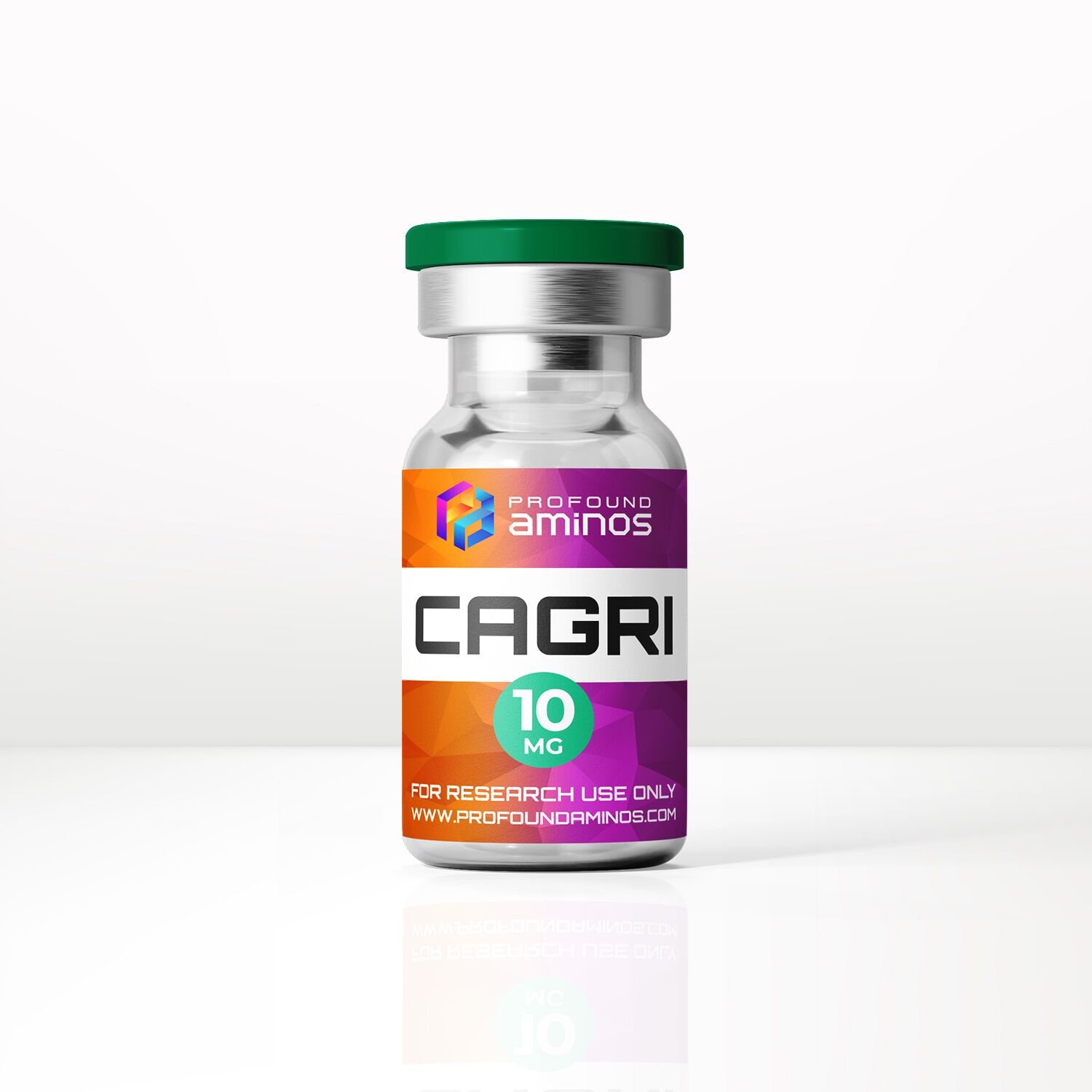
Cagri
Price range: $69.00 through $89.00
Cagri (AM-833; CAS 1393461-38-5) is a synthetic, lipidated long-acting analogue of the pancreatic peptide hormone amylin, engineered for sustained activity at all three amylin receptor subtypes (AMY1R, AMY2R, AMY3R) and the calcitonin receptor (CTR) — classifying it as a dual amylin and calcitonin receptor agonist (DACRA).
A C20 fatty diacid N-terminal lipidation strategy enables albumin binding, reducing plasma clearance and extending circulating half-life to approximately 159–195 hours (~7 days) in pharmacokinetic research studies. Targeted structural modifications (14E/17R salt-bridge substitutions; 25P/28P/29P proline substitutions) simultaneously prevent amyloid fibril formation. Cryo-EM structures published in Nature Communications (2025) resolve Cagri bound to Gs-coupled active AMY1R, AMY2R, AMY3R, and CTR at atomic resolution.
Cagri Long-Acting Dual Amylin & Calcitonin Receptor Agonist (DACRA)
TECHNICAL SPECIFICATIONS
- Product Reference : Cagri — Long-Acting DACRA Research Compound
- Chemical Class : Lipidated synthetic amylin analogue (DACRA)
- Physical Format : Lyophilised powder — hermetically sealed research container
- Analytical Purity (recommended) : ≥98% by RP-HPLC
- Identity Confirmation : LC-MS — molecular weight and sequence confirmation per batch COA
- Reconstitution Buffer : Sterile aqueous buffer pH 4.5–6.0 (optimal for stability)
- Storage — Lyophilised : −20°C or below, desiccated, light-protected, hermetically sealed
- Storage — In Solution : −80°C; single-use research aliquots; avoid repeated freeze-thaw
- Regulatory Class : Research Use Only (RUO) — Not for administration to living organisms
- Endotoxin Screening : <1.0 EU/mg (LAL assay) — required for preclinical model research quality
- COA Requirement : Batch-specific: HPLC purity + LC-MS identity + lot number + stability data
Disclaimer : For Research Use Only (RUO). Not for human use.
Structural & Chemistry Details
| Parameter | Detail |
|---|---|
| IUPAC / Chemical Class | Synthetic acylated 37-amino-acid amylin analogue with C20 fatty diacid N-terminal modification |
| CAS Registry | 1393461-38-5 |
| PubChem CID | 167312356 |
| Development Code | AM-833 |
| Molecular Formula | C194H312N54O59S2 (approximate; 39-residue sequence with lipid chain) |
| Molecular Weight | ~4,409 g/mol |
| Disulfide Bridge | Between residues 3 and 8 (conserved amylin scaffold) |
| Lipidation | N-terminal C20 fatty diacid chain — albumin binding; extended circulating half-life |
| Half-Life (PK research) | ~159–195 hours (~7 days) — Phase 1 pharmacokinetic study (J Med Chem 2021) |
| Fibril Resistance Mechanism | 14E/17R salt-bridge substitutions + 25P/28P/29P proline substitutions |
| Receptor Profile (cryo-EM) | Non-selective agonist: AMY1R, AMY2R, AMY3R, CTR (DACRA) |
| Primary CNS Signalling Locus | Area postrema (AP) and nucleus tractus solitarius (NTS) — confirmed by RAMP1/3 KO studies |
| Key Structural Reference | Bhatt et al., Nature Communications, vol. 16, article 3389 (2025) — cryo-EM; CC BY 4.0 |
Product Overview
Discovery and Scientific Background :
Amylin is a 37-amino acid peptide hormone co-secreted alongside insulin from pancreatic beta cells in direct response to nutrient intake. Its functions in satiety signalling, gastric motility modulation, and postprandial glucose handling have been studied since the 1980s (Cooper et al., 1987). [R2] Despite this pharmacological interest, clinical translation of native amylin was severely limited by its inherent chemical instability — specifically its propensity to form amyloid fibrils and its half-life of only seconds to minutes under physiological conditions. [R2, R3]
Pramlintide (FDA-approved Symlin) partially addressed these challenges using rat amylin sequence substitutions that reduce fibrillation, but its short duration of action necessitates multiple daily research protocols — a practical limitation that drove investment in longer-acting analogues. [R3] The scientific case for improved amylin analogues strengthened when research demonstrated that amylin and GLP-1 receptor agonists suppress energy intake through anatomically distinct but complementary neuronal pathways — the foundation for additive-effect combination research strategies. [R11]
Cagrilintide (AM-833) emerged from a Novo Nordisk medicinal chemistry programme as a structurally optimised, lipidated, long-acting DACRA. The design strategy, SAR data, and Phase 1 pharmacokinetic results were published in the Journal of Medicinal Chemistry in 2021 (Enni et al.), establishing the scientific foundation for Phase 2 and Phase 3 research programmes. [R4]
Molecular Architecture
Cagrilintide (AM-833) emerged from a Novo Nordisk medicinal chemistry programme as a structurally optimised, lipidated, long-acting DACRA. The design strategy, SAR data, and Phase 1 pharmacokinetic results were published in the Journal of Medicinal Chemistry in 2021 (Enni et al.), establishing the scientific foundation for Phase 2 and Phase 3 research programmes. [R4]Five targeted structural modifications are incorporated:
- 14E and 17R substitutions — Stabilise the central alpha-helix through a salt bridge interaction.
- 25P, 28P, 29P proline substitutions — Reduce beta-sheet propensity and amyloid fibril formation — the primary instability mechanism of native amylin.
- C-terminal proline — Enhances potency specifically at the calcitonin receptor (CTR), supporting the DACRA pharmacological profile.
- N-terminal C20 fatty diacid lipidation — Albumin binding; half-life extension (~7 days). Does not reduce AMY3R binding potency vs native amylin. [R4]
- Retained AMY3R affinity — Specifically preserved in the SAR design programme alongside all other modifications. [R4]
Research Mechanism -2026 Laboratory Applications
All applications below are for non-clinical laboratory research use only. No endpoints listed constitute clinical protocols or human-use guidance.
1-Amylin Receptor Pharmacology Research (AMY1R, AMY2R, AMY3R)
Amylin receptor subtypes are structurally defined by heterodimerisation of the calcitonin receptor (CTR) with one of three receptor activity-modifying proteins: RAMP1 (AMY1R), RAMP2 (AMY2R), or RAMP3 (AMY3R). [R6] RAMP1/3 double-knockout studies (Folgueira et al., eBioMedicine 2025) confirmed that cagrilintide’s energy-balance signalling effects are specifically dependent on intact AMY1R and AMY3R function. [R8]
Science Advances research (Weston et al., 2025) further showed that each AMYR subtype exhibits distinct basal subunit equilibria — the ratio of assembled heterodimers to free CTR and RAMP subunits differs between subtypes and determines downstream cAMP signalling amplitude. AMY3R demonstrates the most stable heterodimer assembly due to a stronger RAMP3 transmembrane interaction. [R7]
Research endpoints: AMY1R/AMY2R/AMY3R/CTR binding affinity assays via cAMP reporter systems; RAMP-dependent receptor subtype assembly characterisation; Gs-coupled signalling kinetics via HTRF cAMP quantification; competitive displacement binding studies.
2-Cryo-EM Structural Biology and Receptor-Peptide Interaction Studies
Bhatt et al. (Nature Communications, vol. 16, article 3389, April 2025; DOI:10.1038/s41467-025-58680-y; Open Access CC BY 4.0) resolved cryo-EM structures of cagrilintide bound to Gs-coupled active AMY1R, AMY2R, AMY3R, and CTR simultaneously — the first full receptor-complement structural dataset for any DACRA compound. The structures confirmed cagrilintide’s non-selective receptor engagement and identified RAMP-specific extracellular domain positioning in receptor subtype discrimination. [R5]
Research endpoints: cryo-EM sample preparation for CTR/RAMP heterodimer complexes; comparative structural alignment of DACRA vs selective AMYR agonists; structure–activity relationship studies; lipidation effect on receptor engagement biophysics.
3- Hindbrain Neuronal Circuit Research – Area Postrema and NTS
The area postrema (AP) and adjacent nucleus tractus solitarius (NTS) are the neuroanatomical sites with the highest co-localised CTR and RAMP expression density in the CNS. [R6] RAMP1/3 KO research (Folgueira et al. 2025) confirmed these as the primary anatomical loci for cagrilintide’s central signalling. In wild-type preclinical models, cagrilintide produced statistically significant cFos-positive neuron increases in AP and NTS (P < 0.005). In RAMP1/3 KO models, both neuronal activation and energy-balance signals were substantially attenuated — confirming receptor-specific, region-specific mechanistic dependence. [R8]
Research endpoints: cFos immunostaining in AP and NTS following Cagri research protocols; neuronal population mapping for AMY1R/AMY3R co-expression; hindbrain circuit connectivity tracing.
4 – Concentration-Response Characterisation and DACRA Pharmacology
Research endpoints receptor subtype potency profiling across AMY1R/AMY2R/AMY3R/CTR concentration gradients; combination index analyses for DACRA + GLP-1 receptor agonist models; albumin-binding characterisation and displacement kinetics for lipidated DACRA analogues.
5 – Peptide Synthesis and Analytical Chemistry Research
Cagrilintide’s 39-residue sequence, disulfide bridge (residues 3–8), N-terminal C20 fatty diacid, and multi-position substitutions make it a structurally demanding synthesis target. Modern SPPS (Merrifield 1963; Simon et al. 2014; Mijalis et al. 2017; Hartrampf et al. 2020) provides the methodological infrastructure for research-grade synthesis and analytical characterisation. [R14–R17]
Research endpoints: RP-HPLC purity profiling; LC-MS identity confirmation per batch COA; ThT aggregation assay (fibril formation: Cagri vs native amylin); pH-dependent stability studies in aqueous research buffers (pH 4–7).
Receptor Pharmacology Summary
Sources: Bhatt et al. Nature Commun 2025; Folgueira et al. eBioMedicine 2025; Weston et al. Science Advances 2025
| Receptor | Composition | Brain Region | Role in Cagri Signalling |
|---|---|---|---|
| AMY1R | CTR + RAMP1 | Area Postrema, NTS | Required — RAMP1 KO substantially impairs concentration-dependent energy-balance effects in preclinical models |
| AMY2R | CTR + RAMP2 | Limited CNS expression | Structurally engaged (cryo-EM confirmed); metabolic dependency less characterised |
| AMY3R | CTR + RAMP3 | Area Postrema, NTS | Required — RAMP3 KO substantially impairs energy-balance signalling; most stable heterodimer subtype |
| CTR (free) | CTR only | Multiple peripheral tissues | Co-engaged by Cagri — basis of DACRA vs AMYR-selective classification |
MOLECULAR STRUCTURE
Chemical structure of Cagri
The 2025 cryo-EM structural data (Bhatt et al., Nature Communications) confirmed that the C20 lipid chain creates no steric interference with receptor binding domain engagement.
Cagri (CID 167312356) full molecular structure — C194H312N54O59S2 — 39-residue lipidated amylin analogue showing N-terminal C20 fatty diacid chain, disulfide bridge (Cys3–Cys8), and proline substitutions at positions 25, 28, 29. Source: PubChem CID 167312356, NIH/NLM. For scientific research reference only. Not for human use.
Comparative Research Context — 2026 DACRA & Amylin Peptide Landscape
All compounds below are investigational or approved drugs. No comparison constitutes a product claim. Research context only.
| Feature | Cagri (DACRA) | Pramlintide | Semaglutide | Tirzepatide |
|---|---|---|---|---|
| Compound Class | Long-acting acylated amylin analogue + CTR agonist | Short-acting human amylin analogue | GLP-1 receptor agonist | Dual GLP-1/GIP agonist |
| Primary Receptor | AMY1R, AMY2R, AMY3R, CTR (DACRA) | AMY1R, AMY2R, AMY3R (AMYR-selective) | GLP-1R (hypothalamic) | GLP-1R + GIPR |
| Signalling Region | Area postrema / NTS (hindbrain) | Area postrema / NTS | Hypothalamic arcuate nucleus | Hypothalamic + peripheral |
| Half-Life | ~159–195 h (~7 days) | ~20–48 min | ~7 days | ~5 days |
| Fibril Formation | Minimised — 14E/17R + 25P/28P/29P modifications | Reduced (rat amylin scaffold) | N/A (non-amylin class) | N/A |
| Research Protocol Frequency | Once-weekly subcutaneous research protocol | Multiple daily research protocols required | Once-weekly | Once-weekly |
| Cryo-EM Structures | Available — all 4 receptor subtypes (Nature Comms 2025) | Limited structural data published | Published GLP-1R structures | Published GLP-1R/GIPR structures |
| USA RUO Status | Investigational — not FDA-approved; RUO research only | FDA-approved drug — different class | FDA-approved — not RUO | FDA-approved — not RUO |
| Compounding (FDA 2026) | Cannot be used in compounding under federal law (FDA Feb 2026) | Approved drug — 503A rules apply | Compounding restrictions 2024–2026 | Compounding restrictions 2024–2026 |
Profound Amiono Supplier Quality Criteria (RUO)
Given Cagri’s structural complexity — N-terminal lipidation, disulfide bridge, multi-position substitutions — standard HPLC purity alone is insufficient to verify research-grade quality. Three criteria, drawn from the analytical and regulatory guidance across the source documents, define minimum standards for credible RUO Cagri research supply
1- LC-MS Identity Verification
HPLC purity confirms peptide content but cannot confirm lipidation completeness, disulfide bond formation, or sequence identity. LC-MS confirmation of full molecular weight (~4,409 Da) and sequence identity is required to distinguish intact Cagri from the de-lipidated apo-peptide or from pramlintide/rat amylin — compounds that would produce different receptor pharmacology. Batch COA must include: HPLC purity (≥98%), LC-MS molecular weight confirmation, lot number, and stability conditions.
2-Cold-Chain and Storage Protocol Integrity
Lipidated peptide research compounds are sensitive to thermal degradation, oxidative stress, and hydrolysis of the fatty acid-peptide linkage. Lyophilised storage at −20°C or below under desiccated, light-protected conditions is required. Reconstituted research solutions should be aliquoted for single research protocols and stored at −80°C to prevent freeze-thaw degradation. Suppliers should document cold-chain maintenance from manufacture to laboratory delivery.
3-RUO Labelling Consistency — FDA Compliance Alignment
FDA warning letters (Summit Research Peptides Dec 2024; USApeptide.com Feb 2025) confirmed that RUO labels alone do not prevent enforcement when the totality of website and marketing evidence implies intended human use. [R22, R23] For Cagri specifically, FDA (February 2026) confirmed the compound cannot be used in compounding under federal law. [R21] Suppliers must maintain strict RUO positioning consistently across product descriptions, communications, and all digital content.
REGULATORY & COMPLIANCE STATEMENT (RUO)
FOR RESEARCH USE ONLY. NOT FOR HUMAN OR ANIMAL APPLICATION.
| Classification | Detail |
|---|---|
| Regulatory Status | Research Use Only (RUO) — U.S. Federal Framework |
| FDA Status | Investigational. No FDA-approved Cagri standalone product. NDA for CagriSema submitted Dec 2025 — under review. |
| RUO Intended Use | Non-clinical laboratory research: receptor-binding studies, signalling pathway characterisation, preclinical metabolic models, SAR studies |
| Not a Drug Product | Not evaluated by FDA for safety or efficacy in any clinical application |
| Not a Supplement | Not a dietary supplement, nutraceutical, or consumer product |
| Compounding Prohibition | FDA (Feb 4, 2026): Cannot be used in compounding under federal law — not a component of any FDA-approved drug |
| Intended Use Doctrine | RUO labels do not prevent FDA enforcement if marketing implies human use (FDA warning letters 2024–2025) |
| Google Ads Compliance | No ads implying human outcomes or clinical protocols. Policy updated Mar 31, 2026 — enforcement unchanged |
| Google Search (March 2026) | Spam update targets AI-thin content and misleading health claims. E-E-A-T required |
| FTC Compliance | Health Products Guidance applies. Claims must be truthful, non-misleading, and scientifically supported |
| Safe Wording (FDA-aligned) | “Supplied solely for non-clinical laboratory research by qualified professionals. Not intended for use in humans or animals. No medical claims.” |
| Literature Framing | Published literature is informational and does not describe intended use |
| PPE / Lab Safety | Handle as bioactive compound. Use appropriate PPE and refer to SDS before use |
STRICT PROHIBITION : Distributing, promoting, or using this research compound for any application involving administration to living organisms outside formally approved institutional research protocols is strictly prohibited under U.S. federal law. FDA warning letters (Summit Research Peptides 2024; USApeptide.com 2025) confirm that ‘research use only’ labelling does not shield products from drug-misbranding enforcement where marketing implies human use. Cagri cannot be used in compounding under federal law (FDA, February 4, 2026).
These statements have not been evaluated by the Food and Drug Administration. This product is not intended to diagnose, treat, cure, or prevent any disease.
Frequently Asked Questions
Q1: Is Cagri intended for consumption or human administration?
No. Cagrilintide is strictly a Research Use Only (RUO) laboratory research compound. It is not approved, labelled, or intended for consumption, subcutaneous research outside laboratory settings, or any diagnostic application. Purchase confirms institutional laboratory research use only. Any human-use promotion violates U.S. federal law. [R21, R22, R23]
Q2: What is the difference between Cagri and pramlintide?
Pramlintide is an FDA-approved short-acting amylin analogue requiring multiple daily research protocols (~20–48 min half-life). Cagrilintide differs via: (1) N-terminal C20 fatty diacid lipidation for albumin binding and ~7-day half-life; (2) 14E/17R salt-bridge substitutions not present in pramlintide; (3) C-terminal proline for CTR potency — classifying it as DACRA vs pramlintide’s AMYR-selective profile; (4) cryo-EM structural characterisation across all four receptor subtypes. Pramlintide is a regulated pharmaceutical drug. [R3, R4, R5]
Q3: What analytical data is required per batch COA?
Research-grade batch COA for cagrilintide requires: (1) RP-HPLC purity ≥98%; (2) LC-MS molecular weight (~4,409 Da) and sequence identity confirmation; (3) disulfide bridge formation confirmation; (4) lot number for traceability; (5) storage and stability conditions; (6) endotoxin screening (<1.0 EU/mg by LAL assay). LC-MS is non-optional given the structural complexity of cagrilintide’s lipidation.
Q4: What is the recommended reconstitution protocol?
Published stability data supports aqueous buffer reconstitution at pH 4.5–6.0 for optimal stability. Reconstituted research solutions should be aliquoted immediately for single research protocols and stored at −80°C. Avoid repeated freeze-thaw cycles. Avoid thiol-containing buffers (e.g., DTT) as DACRA compounds undergo redox chemistry with thiols. Design experiments with appropriate redox controls.
Q5: What is Cagri’s FDA regulatory status as of March 2026?
Cagrilintide has no standalone FDA marketing authorisation as of March 2026. An NDA for the fixed-concentration co-formulation CagriSema (cagrilintide 2.4 mg + semaglutide 2.4 mg, once-weekly subcutaneous research preparation) was submitted by Novo Nordisk in December 2025 and is under review. FDA has confirmed (February 4, 2026) that cagrilintide cannot be used in compounding under federal law and is not a component of any FDA-approved drug. Any non-investigational promotion or use is unlawful. [R12, R21]
Q6: What cryo-EM structural data is available?
Bhatt et al., Nature Communications, vol. 16, article 3389 (April 2025; DOI:10.1038/s41467-025-58680-y; CC BY 4.0) resolved cryo-EM structures of cagrilintide bound to Gs-coupled active AMY1R, AMY2R, AMY3R, and CTR simultaneously — the first full-receptor-complement structural dataset for any DACRA compound. Foundational AMYR structural basis: Liang et al., Science (2022), DOI:10.1126/science.abm9609. [R5, R6]
Q7: Does Cagri’s pharmacology differ from salmon calcitonin (sCT)?
Yes — critically. RAMP1/3 knockout studies (Folgueira et al. 2025) showed cagrilintide’s energy-balance effects depend on AMY1R and AMY3R, while sCT’s effects were paradoxically improved in RAMP1/3 KO models — indicating sCT operates through primarily CTR-dependent rather than AMYR-dependent mechanisms. These two DACRA compounds cannot be used interchangeably in receptor-specific research models despite both engaging CTR. [R8]
Q8: What is Cagri’s position in the 2026 USA RUO peptide research market?
Cagrilintide occupies a narrow, high-value niche for amylin receptor pharmacology, DACRA biochemistry, and dual-pathway metabolic signalling research. The USA RUO regulatory environment has tightened substantially since 2024: intended-use doctrine applies regardless of disclaimers (R22, R23), and FDA has specifically named cagrilintide as prohibited from compounding (R21). Businesses in this space must treat compliance as a primary operational requirement — not an afterthought. [R21–R23, R24, R25]
Q9: What content and SEO strategy is Google-safe for Cagri pages in 2026?
Google’s March 2026 spam update (SpamBrain; completed March 24 2026) and concurrent core update targeted scaled AI content, thin health pages, and cloaking — with enforcement concentrated in health-adjacent YMYL niches. [R25] Google-safe cagrilintide RUO content must: (1) anchor all mechanistic and data statements in primary literature (PubMed, NEJM); (2) include explicit authorship, dated revisions, institutional context; (3) use precise scientific language vs keyword stuffing; (4) include zero promissory outcome language; (5) deploy ScholarlyArticle (not MedicalEntity) schema markup to reduce misclassification risk. [R24, R25]
Q10: Can Cagri be used in preclinical model research?
Only within formally approved institutional research protocols (IACUC-approved). Preclinical model research in published literature (RAMP1/3 KO mouse studies; high-fat diet models) was conducted under formally regulated frameworks with full institutional ethics review. Any use outside institutionally approved, ethics-reviewed research protocols is outside the scope of RUO classification. Verify all applicable institutional biosafety, ethics board, and regulatory requirements before any preclinical model research protocol.
KEY REFERENCES : PubMed & Authoritative Sources (2024–2026)
All references are primary peer-reviewed literature or official FDA/Google regulatory disclosures. No secondary aggregators. Verified through March 2026.
| Ref | Source | Type | Relevance |
|---|---|---|---|
| R12 | Novo Nordisk Press Release — Dec 18, 2025 (prnewswire.com) | Corporate / Regulatory | NDA submission for CagriSema; REDEFINE programme; FDA review 2026 |
| R14 | Merrifield RB 1963 — J Am Chem Soc | Foundational Study | Solid-phase peptide synthesis (SPPS) — core method for research-grade manufacture |
| R15 | Simon MD et al. 2014 — ChemBioChem (PMC4045704) | Primary Research | Flow-based SPPS enabling rapid coupling and higher-throughput RUO supply |
| R16 | Mijalis AJ et al. 2017 — Nature Chem Biol (DOI:10.1038/nchembio.2318) | Primary Research | Fully automated flow-based SPPS — scalable peptide library production |
| R17 | Hartrampf N et al. 2020 — Science (doi:10.1126/science.abb2491) | Primary Research | Fast-flow synthesis up to 164 amino acids; functional protein generation |
| R21 | FDA — Feb 4, 2026 | Regulatory | Unapproved GLP-1 drugs: Cagri cannot be used in compounding |
| R22 | FDA Warning Letter — Dec 2024 (Summit Research Peptides 695607-12102024) | Regulatory Enforcement | RUO labelling does not shield from enforcement if human use is implied |
| R23 | FDA Warning Letter — Feb 2025 (USApeptide.com 696885-02262025) | Regulatory Enforcement | Website content overrides RUO disclaimers — intended-use doctrine |
| R24 | Google Ads Policy — Mar 2026 (Google Ads Help) | Platform Policy | Prohibits unapproved substances implying human outcomes; policy updated Mar 31, 2026 |
| R25 | Google Search — Mar 2026 (Search Central) | Platform / SEO | SpamBrain update: penalizes thin AI content, misleading health claims; E-E-A-T required |
RESEARCH USE ONLY — NOT FOR HUMAN USE — NOT FOR ANIMAL USE
| Weight | N/A |
|---|---|
| Dimensions | N/A |
| Strength |
10mg, 5mg |
DISCLAIMER:
- Products sold on our website are meant for scientific research purposes only, designed for in vitro testing and lab experimentation exclusively. These products are not intended to be used as foods, drugs or cosmetics, any sort of bodily introduction of the products into humans or animals is strictly prohibited. They must also not be misbranded, misused, or mislabeled, or used for anything other than research and scientific investigation.
- All the products you see on the website are being sold in a lyophilized powder state (freeze-dried), in a sealed sterile vial; and should be reconstituted.
The product’s label clearly states the amount of product a vial contains; some products are offered in different variations. - The products we are selling come in a sealed vial but require additional lab equipment for proper testing.
- Though we make sure packaging, label, seals and writing does not differ from the product photos you see on our website, there is a chance for a minimal deviation.
Frequently bought together: GHK-CU, Tesamorelin, LIPO-C
Related products
Research Compounds